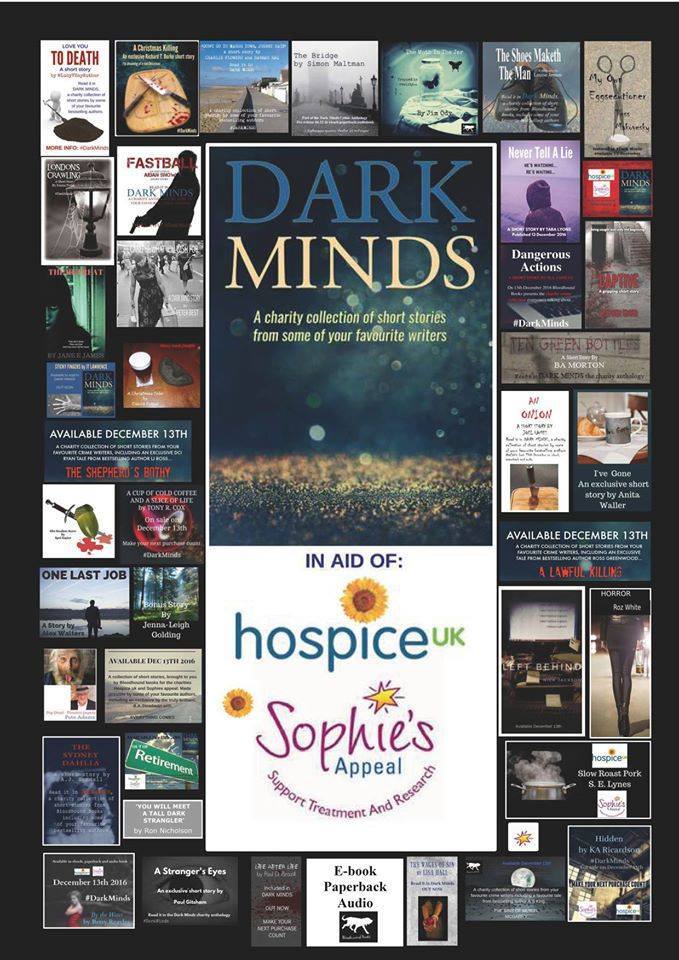
Publishers, Bloodhound books, have done something very special. They have brought together a group of crime authors and each of them has written a short story that together makes up the new book, Dark Minds. The proceeds of the book go to two amazing charities, Hospice UKand Sophie’s Appeal making the book even more special.
You can watch a promo video of the book to get you in the mood, but there are so many authors contributing to Dark Minds that everyone is bound to find something that they enjoy. Perfect Christmas present I think, so much so that my brother will be getting a copy.
I was sent one story to read but I really wanted to support the book and was keen to read many of the stories by some of my favourite crime authors so I also bought an ebook of it. I’m still reading the book but loving it, I’ve never read short stories before, it’s something that I’ve never really been interested in but I think that Dark Minds has changed my mind. I’m enjoying the fast pace and the stories are short meaning that I can read one or two in a sitting which works well for me. At 400 pages the book is a big one, but broken down into smaller stories it is easy to read. As I haven’t finished the whole book yet I’m just going to talk about the stories that I have read.
Author B.A.Morton kicks the book off with the story Ten Green Bottles, telling the story of Zoe who wakes up in hospital, covered in blood that isn’t all her own she slowly pieces together the pieces of what happened and faces the full consequences of her actions. Is it her fault that people died?
Next Emma Pullar gives us something completely different. Jody leaves work to find London deserted, a thick fog covers everything and she has no mobile reception. As she walks the empty streets she can’t help feeling spooked but is there a good reason for that? Of course there is! This book was really creepy and definitely got under my skin!
The fabulous Louise Jensen‘s The Shoes Maketh The Man gives us some twists and turns as Bill, an old man living in a nasty area fearful of being attacked in his own home like many other pensioners in the area. When he hears his upstairs neighbour Bill’s reaction is not what you think it will be, that’s for sure! She has another book out this week, The Gift, and this short story has made me determined to read it soon.
Then comes Never Tell a Lie by Tara Lyons who co-authored The Caller which I really enjoyed. I loved her story about a man working in a coffee shop and looking for the woman for him. He has some unusual ideas about what that might mean though!! Yikes.
Richard Burke gives us his story, A Christmas Killing about a man who gets an intriguing delivery and has some very strange things in his fridge. The story leaves you guessing and trying to get your head around just what it is that is in his fridge.
Author Betsy Reavley who has published two brilliant book this year, The Optician’s Wife andFrailty, doesn’t disappoint with the unsettling By The Water, about a woman who finds herself in a river covered in blood, did a doctor’s attempt to cure her from her mental health problems actually cause more damage?
Next up is Tony Cox with his story, A Cup of Coffee and a Slice of Life. A man in a cafe overhears two old ladies talking about old times, it all seems innocent until the woman start to talk about events that are anything but innocent. This story gave me the shivers.
S.E. Lynes gives us Slow Roast Pork, a woman’s husband goes missing and she deals with it by cooking. Guests get given plenty to eat, including the police who particularly enjoy her roast pork. But is all as it seems?! This one got under my skin, and the end was not what I was expecting!
Finally, I read Paul Gitsham‘s story, A Stranger’s Eyes. In this story, we follow a man who wakes up in a hotel room, beaten and bloodied he can’t remember anything, not even who he is. In his room, he finds a stash of money and soon enough a knock at the door tells him that whatever he has done, the police want to talk to him about it. Panicked he runs, but what is it he did and will he get caught by the police?
So far I have enjoyed all of the stories and I hope that many of you are tempted enough to buy a copy for yourself or for someone as a present. It always feels even better buying something when the proceeds go to two amazing charities. I will be publishing my full review when I have finished the complete book.
The Food of Love is my first Amanda Prowse novel, but it certainly won’t be the last. I’ve heard a lot about the author and her books on Facebook book pages and kept wanting to read them but never quite getting round to it. But when I read the blurb for The Food of Love I really wanted to read it. So I did.
What I read was a very well researched book that told the story of a family torn apart by anorexia.
Food had always played an important part in the lives of the Braithwaite family, Mum Freya spends her days writing about food and every meal was a veritable feast. Youngest daughter Lexi was on a health kick, having grown up slightly podgy she was running regularly and Freya was happy with this change. She put it down to Lexi’s interest in a boy at school.
When Lexi’s school called Freya in to talk to her about their concerns about Lexi and the fact that she was losing weight and not eating Freya dismissed their concerns. She knew her daughter and she’d sat with her at the kitchen table every night watching her eat her dinner. Husband Lockie agreed with Freya and family life continued.
Soon enough Freya was forced to accept that maybe Lexi did having a problem with eating, something that was clearly very uncomfortable for her to face, Lexi had a healthy dose of denial about the seriousness of Lexi’s problem.
I loved how the book was written, how each member of the family dealt with what was happening differently and how it pulled the family apart. I especially loved the relationship between Lockie and Freya, could such a strong and loving relationship handle anorexia in the family?
I think that The Food of Love will really open people’s eyes about anorexia and the shocking impact that it can have, and the lengths that someone with anorexia will go to in order to hide it. I know that many don’t understand why the person just can’t eat and get on with it, but this book cleverly shows the reader how it really isn’t that simple and how distressing anorexia can be for the sufferer but also for those around them. If you know someone with anorexia and struggle to understand it then read this book, if you have a friend whose daughter is anorexic then read this book and if you are the parent to young children then read this book.
Although The Food of Love wasn’t always easy to read I found it such a good book and one that sucked me right in, took me on a real emotional rollercoaster and made me care for the family. Sure, at times I wanted to shout at Freya to kick her out of her denial and her insistence that she could make Lexi better, but I also understood and empathised with where she was coming from.
I for one look forward to the next Amanda Prowse book that I will read, she is definitely an author to follow.
I received a copy of The Food of Love from Netgalley, this has not affected my review.
Blurb:
A loving mother. A perfect family. A shock wave that could shatter everything.
Freya Braithwaite knows she is lucky. Nineteen years of marriage to a man who still warms her soul and two beautiful teenage daughters to show for it: confident Charlotte and thoughtful Lexi. Her home is filled with love and laughter.
But when Lexi’s struggles with weight take control of her life, everything Freya once took for granted falls apart, leaving the whole family with a sense of helplessness that can only be confronted with understanding, unity and, above all, love.
In this compelling and heart-wrenching new work by bestselling author Amanda Prowse, one ordinary family tackles unexpected difficulties and discovers that love can find its way through life’s darkest moments.
So, today we have something a little bit different on If only I could read faster. It isn’t often that I review a non-fiction book, but I have always supported Sarah Rayner’s non-fiction books and so when she released a new one I wanted to help her let more people know about her books.
I sort of feel like this is a bit of a ‘coming out’ post for me, I am not someone who is open about their mental health struggles, I’ve always been a private person and I guess aware of the stigma around mental health. But I do think that that stigma is not the same as it used to be, I certainly hope not anyway, and I don’t think that keeping mental health struggles quiet is helpful to the person who has the struggles, or those that are close to them. So I have been thinking for a while that it would be good to be more open about my experiences, I was just unsure how to go about that.
So reviewing Making Friends with Depression and doing a Q&A with Sarah Rayner is my way of ‘coming out’ about my own mental health struggles. I have been a member of the Facebook group, Making Friends with Anxiety (now Making Friends with Anxiety and Depression), for a couple of years now, and although not a very active member the group has at times been very helpful, although for me anxiety is not my main struggle. My battle is with depression, severe and debilitating depression. It is something that I struggle with in some way or other pretty much every single day, although thankfully with the right support and treatment I am able to function in the sometimes scary world.
Making Friends with range by Sarah Rayner.
My 4* review:
Having read Sarah Rayner’s previous non-fiction books focusing on anxiety I was keen to read her latest book about depression. Rayner has a great way of talking to her audience, it really does feel like you are chatting with her in person when you read. Her style is light and certainly not preachy.
The book is broken down into chapters that spell the word Depression. So chapter one talks about diagnosis, where the book talks about what depression is and the various symptoms, two about expert support including guidance on talking to your doctor and medication and so on.
This means that reading the book is broken down into simple, easy to read topics. In this book Sarah is also joined by another author who has struggled with depression, helping to give different viewpoints and experiences, and by a GP who gives his professional experience too. Although Rayner is the main narrator the book does benefit from the other contributors.
Perhaps the most important contribution comes from people who struggle with depression. In researching this book Rayner carried out a number of online questionnaires in order to get as a wide an experience as possible as no one with depression has the same experience as another. There are regular quotes in the book from these responses (including one from me) and I found these to be helpful and I think would definitely help someone in the middle of a depressive episode to feel less alone.
One of the chapters does focus on crisis care, where they advise on what to do and where to get help in an emergency situation, but the rest of the book is aimed at people who are struggling with depression but not, in my experience, a severe episode.
I know from my own experience that if I was at a really low point then this book would be of very limited help to me, but if I was at the start of a depression and if you like, caught it early enough, then this book would be a great help and reminder of things that I can do to help get myself out of it before I go too far.
I think that this book would be particularly useful for someone who is new to depression, and perfect for someone who is just starting to accept that they have depression as this book will educate them in a non-judgemental, easy to follow way. It would also be very helpful for a friend or family member of someone with depression.
This is a light and easy to read book, and I’ve no doubt that many will gain a lot from reading it. I do feel that if someone is struggling with severe depression then this book would have limited use.
The final thing to note about this book are the many wonderful illustrations. Rayner, it turns out, is something of an artist and she has drawn lots of pictures for the book. Although in Kindle format these illustrations are often not fully legible, especially small writing, which is unfortunate, although I believe this is only the case with e-readers and not if you use a kindle app on tablet or phone. I think that this is one book that would be better to read in hard copy so that you can make notes, perhaps highlight parts, and enjoy the illustrations.
Sarah Rayner.
Q&A with Sarah Rayner:
You started off writing fiction. What made you change to writing non-fiction books?
I didn’t deliberately set out to change from one to the other – in fact I’ve always written non-fiction, just not in book form, as for twenty years my ‘day job’ was advertising copywriting. So you may have read my work in magazines or on the tube, but not been aware I was the author! Some people might say that advertising is a form of fiction, but I found that composing letters, brochures and advertorials good training when it came to writing my non-fiction titles, as I learned how to sift through information and pare it down so I could write about complex subjects in an accessible way.
Then, when I was launching my novel Another Night, Another Day, which focuses on three people who meet in a psychiatric clinic, I was invited to write a series of blogs for Moodscope, a website which allows you to track your moods on a daily basis. I decided to focus on panic and worry as I’d personal experience of anxiety, and each day for a week explored a different area related to subject, starting with ‘A’ for ‘Adrenaline’ and finishing with ‘Y’ for ‘You’, so that after seven days I’d spelt out the word ANXIETY. I researched each subject carefully – not least as I stood to benefit myself! – and had the content checked by a GP to make sure the advice I gave was responsible. The reaction to those blogs was so heartfelt – it seemed there were a lot of people out there who were as desperate as I had been – that it led me to believe there was an opportunity to offer anxiety sufferers something more permanent that they could turn to whenever the need arose. So I set my hand to penning Making Friends with Anxiety, a little self-help book where I drew upon my own experiences and learnings in order to help others help themselves. Because I’d experience of marketing, I decided to publish the book myself, curious to see what ‘independent publishing’ was really like, and discover I could make it work financially and aesthetically as well as reaching out to a new readership.
2. Have you always been open about your mental health struggles or did you make a conscious decision to tell people about it when you wrote Making Friends with Anxiety?
My father, Eric Rayner, was a psychoanalyst, so an interest in mental health is in my blood. He recently passed away but his intellectual influence on me was always strong, and I remember asking him to direct me to books on people with multiple personality disorder when I was 17 as there was a song by Siouxsie and the Banshees – remember them? – called Christine, which focused on a woman with the condition. However it took several decades before I was ready to write about mental illness myself – maybe because he was so erudite! So whilst I touched on it in my other novels, it wasn’t until my fifth book, Another Night, Another Day, that I made it the focus of the story. When launching Another Night, Another Day it seemed relevant – and important in terms of overcoming stigma – to speak of my own experiences – and since then I’ve been much more open. I would encourage others to talk if they feel up to it, too, as whilst I still have dark days, I believe bottling up emotions or trying to cope on our own often makes us feel much worse.
3. You began with Making Friends with Anxiety, followed by colouring and craft books, and a book on the menopause. Why did you decide to focus on anxiety and the menopause before writing your latest book on depression?
Depression is arguably the obvious successor to a book on anxiety as both are frequently diagnosed together, but my anxiety had escalated enormously in the run up to the menopause, and I became interested in the link between hormonal changes and panic so for me the subject of menopause was the natural follow-up. I was also wary about dealing with the sensitive subject of depression on my own; using my experiences as the sole basis for extrapolating advice aimed at a wide audience, many of whom would be in a highly distressed state, seemed unwise and potentially dangerous. But when my fellow author Kate Harrison and doctor friend Patrick Fitzgerald expressed an interest in collaborating, I became inspired by the prospect of what we might do together. And when the team of wonderful volunteers who help run the ‘Making Friends with Anxiety’ group on Facebook offered to expand the group to include sufferers of depression too, I finally felt we had a ‘net’ so to speak, capable of supporting people in a way that I could never offer alone. Once I had sorted those elements, I felt able to embark on the project and I’m thrilled with how the book has turned out.
4. You asked people to fill in online questionnaires when you were researching Making Friends with Depression, did you learn anything surprising from doing that?
The survey was Kate’s suggestion: she uses a similar technique to help research her 5:2 diet books. I was astonished by the huge number of responses we got, and the honesty of the replies. I think perhaps because they could remain anonymous, people felt more able to express themselves. We asked all sorts of questions (readers can see the survey here, and it helped us understand not only how differently individuals experience depression, but also the commonalities. I was interested to learn how many people had had some form of therapy through the NHS – that’s a big and positive change and one that has happened in the last five years. What is less good is that a great number of respondents felt the therapy had stopped too soon. It’s my hope that our book will enable those who feel bereft of support either begin or continue to help themselves – because recovery is possible.
5. Why did you decide to start the Making Friends with Anxiety Facebook page?
One important distinction is that it’s a group not a page, which means that members have to ask to join. This means they can discuss their issues with others in confidence, and I know from my own experience of being in groups that talking to others with similar experiences can go a long way towards helping us feel more connected to others and confident. To explain the benefits more fully, I asked the members. Here are a few responses:
“Making Friends with Anxiety means I’m not alone anymore, like-minded people are always available on my mobile. People that I now consider friends.”
“🙂It’s somewhere I can be myself, where I’m understood, nobody will judge me or call me a nutter or tell me I’m being stupid. People are so warm and caring – it’s like a big fluffy comfort blanket!”
“This group makes me feel not so insular. Never have I spoken completely honestly about my anxiety or what it has caused me to do or feel. I have a voice, I am not alone and everyone on this site is so supportive and kind which is exactly what you need when you feel low. It is like a little supportive family when you don’t have your own to turn to.”
6. You have drawn a lot of drawings for Making Friends with Depression, and you’ve released two books on creativity and mental illness. How do you think that being creative helps your mental health?
I’ve noticed that when my brain is tired of writing that I still have energy to draw; this may be because they involve different neural pathways. In any case, I feel we can often say a lot more with a drawing than with words, and illustrations were a way of ‘lightening up’ the book without being flip. I found myself smiling as I drew, feeling empathy for the characters I was creating. So there are two examples of how being creative helps lift my spirits, and others who suffer with anxiety or depression have said similar. Kate writes about cooking in the book for instance, and how it enables her to combine self-care and creativity. Patrick is a musician as well as a GP – my guess is that it helps him unwind from listening to patients’ problems to thrash about on a guitar!
7. You’ve become a champion with all the work that you do around mental health; writing books, an active role on the Facebook page and your regular feature in Psychology Today.
8. Was this something that you wanted to do when you set out to write Making Friends with Anxiety?
When my father was a young man, he was a naval officer and he visited Japan in the aftermath of Hiroshima. He was horrified by what he saw there, and it was this experience that led him to work in mental health – he wanted to understand why people could be so destructive, when he believed that basically humans are social and good. He spent over 50 years campaigning for better mental healthcare. My motivations are not the same, but I do appreciate where he was coming from in trying to build bridges between people. I don’t believe there is a one-size-fits-all ‘cure’ for depression or anxiety or grief, but I do I believe understanding ourselves can give us greater freedom from mental illness, and the support of others can help us through dark times.
9. Do you have plans to write more books on mental health or will you return to fiction?
Hopefully both! I’ve just relaunched my first novel, The Other Half, as an ebook with illustrations – it’s probably the furthest from Making Friends with Depression that it’s possible to be. This link should allow you to look inside, and you’ll see what I mean!
It tells the story of an affair from the alternating perspectives of the wife and the mistress and is half price to download between Friday 16 and Sunday 18 December as a present to all my readers – and yours – so they can treat themselves to an illicit affair via my novel over Christmas should they fancy it.
Thank you so much for inviting me onto your blog, Becca. It’s been really interesting to get this chance to talk about all my books, and keep up the great work!
Sarah Rayner’s fiction books.
Thank you so much for answering all the questions Sarah, and for the half price download of The Other Half! It has been great to have you on If only I could read faster and I wish you lots of luck with future books.
All of Sarah Rayner’s books can be found on Amazon UK and Amazon US. I particularly recommend One Moment One Morning.
Yesterday I was lucky enough to go and see Jodi Picoult talk about her latest book, Small Great Things. She is touring the world to spread her message of what she sees as her most important book yet, and the hardest book that she has written.
You can read my review of Small Great Thingsand it is out now to buy, and I hope that you do buy it, as it is an important book and one that I think people should read.
The timing of the release of Small Great Things is pretty amazing, given that the book focuses on prejudice, something that seems to be so prevalent in the world, with hate crime rising drastically in the UK after the Brexit vote and in the US after Trump won the election there. With France looking like they will also be electing someone who incites hate, perhaps this book is needed now more than ever?
Picoult kicked off by reading the start of the book, introducing the audience (the huge majority of whom wouldn’t have read the book yet) to Ruth, one of three storytellers that take the reader on a journey through Small Great Things. Ruth is a nurse in America, and Ruth is black. Something that two new parents won’t tolerate and so ask that she has no involvement with their care. This causes events to spiral in ways that none dreamed possible, but we follow Ruth as she fights for her job and then her freedom as a result of what happened that day.
When I read Small Great Things I was struck by how much research Picoult had clearly done in order to write the book, her terminology around Ruth’s job was spot on, she obviously knew her stuff. But hearing her talk yesterday about the research that she did totally blew me away.
She was very aware that as a white woman she did not understand what people of colour go through. I say people of colour as that is the term that Picoult uses, it is the current term that is used in America and apparently preferred by many as it includes not just black people but also latinos, Asians and anyone with a skin colour that is not considered white.
So knowing this Picoult set about doing her research. She spent 100 hours with ten black women, talking to them extensively about their lives and their experiences and prejudices that they had encountered in their lives. What she heard shocked her, and she says, changed her forever. Two of these women then read the book as she wrote it to make sure that her terminology was ok and that Ruth’s voice sounded authentic.
Picoult also did a course in Social Justice, she told us that after every lesson she would come out and cry. Her eyes were opened and she felt inspired to write Small Great Things.
The idea for the book came from a newspaper story about a labour and delivery nurse in America who was told that she was not to care for a family who were white supremacists. That nurse went on the sue her hospital for discrimination but Picoult decided to take the story further, in that what if something went wrong with the baby and the black nurse had been the only one present, torn between helping the baby or obeying her orders not to touch it?
In order to complete her research Picoult also met with two ex-white supremacists, to find out about their thinking and their lives. The stories that she told us about what they had told her were shocking and scary, especially given what is happening in the US right now.
When I read Small Great Things I often wondered what black women would think of it, and in fact, I pondered this in my review. So I was pleased to hear Picoult talk about this, she said that the response had been amazingly positive, that she had had fantastic feedback from people of colour. When an audience member asked Picoult what the reaction had been from white supremacists, Picoult smiled and told us that they were not going to be reading her book in the first place. But she had written an article for TIMEmagazine about her book and had received a number of highly offensive and threatening tweets on Twitter. I have just looked at that article for the first time and it repeats a lot of what I have written here, but no doubt in a far more eloquent way.
Before we went into the hall I got talking to a woman behind me in the queue, she was a black woman and had at the last minute decided to go and listen to Picoult talk. When it was finished we saw each other on the way out and she told me that it had been amazing, she was so pleased that she had gone, that it had been powerful and how, as a nurse in the NHS she felt that she had been passed over for promotions, and had felt that she had been treated differently because of her skin colour many times. This book really is so relevant today in this world. This book needs to be read, now more than ever.
A Mother’s Confession tells the story of Olivia and her marriage to David. We know that together they had a baby called Zoe, but over the book the truth about their marriage becomes clear.
Ivy, David’s mother, also part narrates the story, telling us about her son who can do no wrong. She devoted her life to her son and became heavily invested in him and his life, wanting to know about and be part of everything. Ivy and Olivia always had a difficult relationship with Ivy struggling with jealousy when David met and fell in love with Olivia.
We know early on that David had a darker side to him, and that he is now dead. But we don’t know what happened that tore Olivia’s world apart. It is clear that Olivia has no desire to interact with her in-laws, but also that her relationship with her own family has been fractured but that since David’s death it has been rebuilt.
Olivia is attempting to move on with her life, she wants to be a good mother for her daughter Zoe and is keen to get back to work as a vet. Living in a small town where everyone seems to know everything about everyone proves challenging for Olivia, but as she gets stronger she starts to move on with her life and to tell us what when so badly wrong between her and David.
I just loved this book, I felt quickly immersed in the story and wanted to keep reading it to find out exactly what had gone on. At times I thought that I had worked it out, but of course, I hadn’t. I loved that the story was told by two mother’s, meaning that the reader was never really sure which mother had a confession to make.
I have read a few books by Kelly Rimmer now and all have been excellent, but I think that this one has to be my favourite. It was wonderfully told and although not always easy to read, I thoroughly enjoyed it.
Thank you to the publisher Bookouture for a copy of A Mother’s Confession via Netgalley. I was under no obligation to give a review.
A Mother’s Confession by Kelly Rimmer is out now and available from Amazon UK and Amazon US.
I loved The Optician’s Wife by Betsy Reavley, it was an incredibly well-woven story that at times turned my normally strong stomach. So I was excited when I heard that the author had another book coming out and even happier when I was given an ARC of Frailty to read and given the opportunity to be part of the blog tour. So here is my review.
My 5* review:
I really wasn’t sure what to expect when I started to read Frailty, I knew little about it, only that it involved child abduction, a topic that can be hard to read, especially for those of us that are parents ourselves. Was I sure that I really wanted to read it?
Of course I did! I rarely shy away from reading a book about a difficult topic and so with Frailty bumped to the top of my TBR pile I started to read it. I was quickly drawn into the story, it often takes me a while to get into a book but not this one, from the very start I had to know what was going to happen.
When Hope goes missing her parents, Libby and Danny are thrust into a nightmare that they never wanted to be part of. They don’t know who to trust and where to turn as the police seem to keep coming up blank, they have no idea where little Hope could be.
The parents descend further and further into the nightmare, both behaving and thinking things that they had never believed that they would or could think or do. It was heartbreaking to read, and I really felt like I was there with them, powerless to help them.
Periodically we heard from little Hope herself, and those chapters were especially hard to read but were also an essential part of the story.
As her father, Danny struggled with Hope’s disappearance, he felt that as the man of the house is role was to keep his family safe. And at that he had failed, something that felt like a heavy burden to him and eventually forced him into something that clearly showed the reader how he had been destroyed by the disappearance of his eldest daughter. This was the one part of the book that I wasn’t quite sure about, would someone be driven to go so far and to act so out of character?
By the end of the book I felt as though I wasn’t quite breathing normally, I’m sure that I held my breath through a number of chapters while I waited to find out what had really happened to Hope. And although I had a big part of it worked out, that didn’t detract from the story in any way.
The emotions that I felt reading Frailty tell me how well the story was woven and how as a reader I was drawn into the story. After I finished it I thought about the book a lot, another sign that it had got under my skin.
I’m aware that someone reading this review might question why I would want to read a book such as this, and why I think that someone else should too. That is an easy question to answer, I love a book that takes me on a journey and that immerses me into the story, the author does both very well. This really is a special book.
I received a copy of Frailty from the publishers but was under no obligation to review the book. My opinions are my own and have not been affected by this.
Blurb:
How far would you go to protect your family?
Danny and Libby are about to face every parent’s worst nightmare.
When eight-year-old Hope Bird disappears without a trace, from the idyllic village where she lives, life for her family will never be the same again. Her parents know she would never have gone off alone and the police have no idea where she is. Then a child’s shoe is discovered and the case takes an unexpected turn. Soon a suspect is identified but this is only the beginning.
Will they ever find Hope?
Frailty is a haunting, gritty, psychological page-turner about the choices we make. How far would you go to protect your family?
Danny and Libby are about to face every parent’s worst nightmare.
When eight-year-old Hope Bird disappears without a trace, from the idyllic village where she lives, life for her family will never be the same again. Her parents know she would never have gone off alone and the police have no idea where she is. Then a child’s shoe is discovered and the case takes an unexpected turn. Soon a suspect is identified but this is only the beginning.
Will they ever find Hope?
Frailty is a haunting, gritty, psychological page-turner about the choices we make.
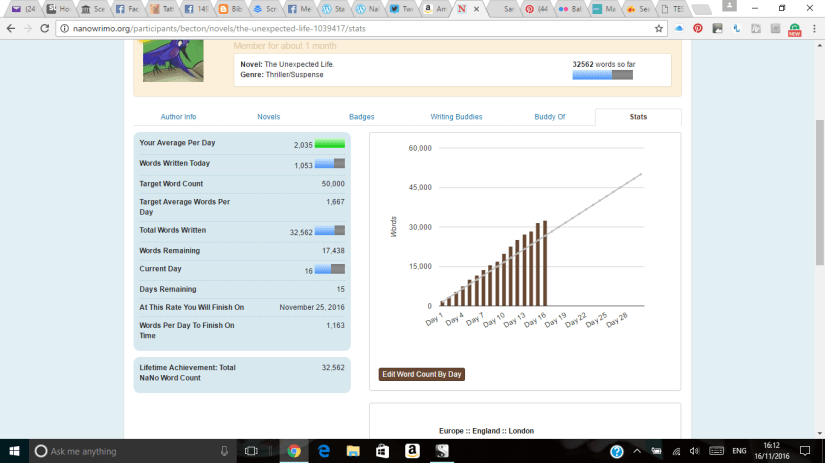
So, today is day sixteen on NaNoWriMo, six days since my last update. My wordcount now sits at a staggering 32,562 words.
As you can see from the graph above I am ahead of schedule which is hard to believe, I’m not sure that I’ve ever been ahead of schedule on something before. Seriously, I’m one of those people who normally never gets to the end and if I do it’s a last minute rush to make it. But I’m approximately 5,000 words ahead of target.
It feels good to have that buffer, although I do have a few days coming up where writing will be difficult, if not impossible. But I’m not going to focus on that right now.
There have been no major dramas since my last update, I feel like I’ve settled into a routine with it and although sometimes I feel like I have absolutely no idea where to go next, somehow words come and the story moves on.
Talking of the story I happen to think that it is a load of rubbish, complete drivel in fact. I think that I have far too many frowns in the book, ‘he looked at her and frowned’ ‘she frowned and said….’. I definitely need to look up words that I can use as an alternative to frown!
Another thing that I’ve been struggling with is animal related. It seems that vets are hard to find, and even more so vets that are willing to talk to you about the not so pleasant side of what some people do to their pets. If you’re reading this and are a vet and are willing to help then please get in touch! I promise that it is for my book and not something that I will be putting into practice.
Something elset that I think that I should tell you is that my daughter has been sick. In fact when she vomited my second thought was ‘oh no, how am I going to get my writing done now?’ which was a pretty selfish reaction when my five year old had just thrown up. She was sick twice and then absolutely fine, a little quiet the next day which meant that I actually got a lot of words done but then totally normal today. She’s spent the day telling me that she wished that she was at school and that she missed her twin brother, in fact she seems to have barely stopped talking all day.
In the end I took her to Costco, I wasn’t getting any writing done so figured that we may as well do something productive with our day. After we sat and had a drink and she sat quietly, I told her that she finally had my undivided attention so what did she want to talk to me about. Her response? A small shrug and she sat drinking her drink and for the first time all day, she was quiet. Typical. However, since getting home from school she has happily played with her brother and I have managed to finally get some writing done.
Under 20,000 words to go. I can’t tell you how much I want to get there. Although in general I’m enjoying doing NaNo it is exhausting. Today I promised myself that I wouldn’t do NaNo again, but I have a feeling that NaNo is a bit like childbirth and soon enough I’ll forget the bad bits and want to do it all over again.
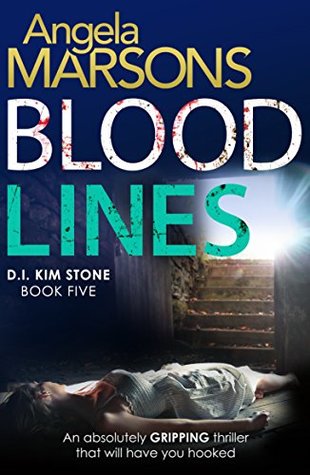
I am super excited to be part of the blog tour for Blood Lines by Angela Marsons. As you might know I’m a huge fan of the Kim Stone series. You can also read a Q&Athat I did with author Angela Marsons and my review of Play Dead, also in the Kim Stone series and The Forgotten Womanwhich is a standalone book.
But today we are here to celebrate Blood Lines, the fifth book in the amazing Detective Kim Stone series.
Blood Lines by Angela Marsons.
My 4.5* review:
If you’re a regular reader of If Only I Could Read Faster then you will know that I am a huge fan of author Angela Marsons and her Detective Kim Stone novels, so it was with much excitement that I started to read Blood Lines.
Blood Lines is book five in the Kim Stone series, and although Marsons has always been clear that they can be read as standalone books, as time goes on I think that the reader would definitely benefit from reading the series from the start. And frankly, if you didn’t you’d miss out on some brilliant books.
Marsons is signed up to write a whopping 16 Kim Stone books and I have to admit that as much as I love the character I am unsure how Marsons will manage to maintain her for that many books. But thankfully she appears to be a long way from running out of steam with Blood Lines.
Book number two, Evil Games, featured a character that was so brilliantly written that she scared the bejeebers out of me. it was one of the best portrayals of a sociopath that I had read. So when I heard that Alex Thorne was to make another appearance in Kim Stone’s life I was even more excited.
For some reason, the relationship between Stone and Thorne just didn’t click for me in the same way and Thorne did not make my skin crawl as she had in Evil Games. This was disappointing for me. I felt that Stone dealing with Thorne and the chaos she was creating took up a lot of the story, but at the same time Stone was the lead detective on a puzzling murder investigation. For me, I think that it would have been better for the story to focus on one of these things, and to save the other for another book, as I felt that neither could be dealt with satisfactorily.
Having said that Blood Lines is still a very good book and will no doubt satisfy the many Kim Stone fans desperately waiting for another book in the series. I was pleased that we got a teeny bit more about Stacey and Kevin, two of Stone’s team but I’d love Bryant and Stacey to feature more.
Marsons is a skilled writer who is able to write in a way that makes the stories flow and feel so real. I’ve said it before but I do feel that each time a new Stone book comes out I get to catch up with a friend. The Detective Kim Stone books have been phenomenally successful and Blood Lines doesn’t let the team down and it gets a great 4.5* from me.
Thank you to the publishers, Bookouture, for a copy of Blood Lines.
Blurb:
How do you catch a killer who leaves no trace?
A victim killed with a single, precise stab to the heart appears at first glance to be a robbery gone wrong. A caring, upstanding social worker lost to a senseless act of violence. But for Detective Kim Stone, something doesn’t add up.
When a local drug addict is found murdered with an identical wound, Kim knows instinctively that she is dealing with the same killer. But with nothing to link the two victims except the cold, calculated nature of their death, this could be her most difficult case yet.
Desperate to catch the twisted individual, Kim’s focus on the case is threatened when she receives a chilling letter from Dr Alex Thorne, the sociopath who Kim put behind bars. And this time, Alex is determined to hit where it hurts most, bringing Kim face-to-face with the woman responsible for the death of Kim’s little brother – her own mother.
As the body count increases, Kim and her team unravel a web of dark secrets, bringing them closer to the killer. But one of their own could be in mortal danger. Only this time, Kim might not be strong enough to save them…
A totally gripping thriller that will have you hooked from the very first page to the final, dramatic twist.
I absolutely loved Little Black Lies by Sharon Bolton so I was keen to read Daisy in Chains. As people read it the buzz about the book grew and grew, but I do try and avoid reading buzz books when it is being talked about so much as I think that it generally leads to high expectations that often aren’t met. So I thought I’d wait a bit. Sadly the wait was far longer than I had intended.
As with Little Black Lies the scenery once again plays a huge part, it becomes almost like a character itself. I love the way that Bolton describes the weather and the setting so well, she has a real talent for it.
The concept of Daisy in Chains is an interesting one, a lawyer who works tirelessly to get convictions overturned, seemingly without any care of consideration of whether the person is guilty or not. When she meets Hamish, a convicted murderer, the reader is unsure whether he is guilty or not, there do seem to be some strange things about his case, but his behaviour doesn’t seem to be suggesting that he is innocent either.
At getting on for 400 pages this is not a short book, and I do think that it would benefit from being a bit shorter, it is hard to keep the tension going for that long.
But there are plenty of twists and turns, some of them more obvious than others, and the reader will be taken on a journey and immersed in the world that Sharon Bolton creates.
Thank you to Netgalley and the publishers for a copy of Daisy in Chains.
Blurb:
Famous killers have fan clubs.
Hamish Wolfe is charming, magnetic and very persuasive. Famed for his good looks, he receives adoring letters every day from his countless admirers. He’s also a convicted murderer, facing life in prison.
Who would join such a club?
Maggie Rosie is a successful lawyer and true-crime author. Reclusive and enigmatic, she only takes on cases she can win.
Hamish is convinced that Maggie can change his fate. Maggie is determined not to get involved. She thinks she’s immune to the charms of such a man. But maybe not this time . . .
Would you?
Daisy in Chains by Sharon Bolton is out now and available from Amazon UK and Amazon US.
I need to be honest, I have absolutely no idea what I was thinking when I decided that I would read Snowflakes and Christmas Cakes. I don’t ‘do’ chick lit. If I’m honest I’m probably a little bit snobbish about it.
So I started the book with rather low expectations. But I do not mind admitting that I was wrong, very wrong. I really, really enjoyed reading Snowflakes and Christmas Cakes, the characters were interesting and believable. I often thought that the outcome was very obvious, but it wasn’t! The author kept me on my toes just enough, while weaving a lovely story. It made a nice change from the crime and thriller books that I normally read, and probably quite a healthy change at that.
While Snowflakes and Christmas Cakes was a nice, easy read, I did not want it to finish. When I did I saw that there was a sequel. Yay, I was so going to read that. And then I saw that there are, in fact, six books in the series! I hope to make my way through all of them over time.
I really liked the Lake District setting, and although I’m typically very Bah Humbug until about a week before Christmas the Christmas setting didn’t put me off, it didn’t play a huge part in the story.
If you like chick lit then read this. If you don’t normally read chick lit but think that a change of genre would be good, then read this. It’s good!!
Chapter One.
“Have you checked in yet, Millie?”
“Yes, Nicole, I have! Don’t panic. I told you I’d make an extra special effort to arrive in
plenty of time, didn’t I? I’m relaxing in the Departure Lounge with a caffè latte and the latest
edition of Voici, soaking up the last rays of sunshine I’ll see for the next two weeks.”
She had no intention of admitting to her super-organised sister that Monique and Hélène
had insisted on collecting her from her bedsit above Brasserie Étienne, then driven her at
stomach-wrenching speed to Nice airport and marched her, still stuffing her passport into her
hand luggage, to the check-in desk. They’d even had the audacity to hang around whilst she
wound her way through security just to make absolutely sure she didn’t meet with some
diversion and miss her flight – not an unknown, or indeed infrequent, occurrence.
“Typical. Just this once I hoped you’d stuck to your usual schedule of taking every
deadline to the wire!”
Millie detected a note of anxiety rather than impatience in Nicole’s voice. “Why? What’s
wrong?”
“I’m so sorry, Millie. It’s Édouard’s father. He’s had a stroke – been rushed into hospital in
Paris. His mother’s frantic – not sure whether he’ll survive the night.” Millie heard her
younger sister gulp down her emotions. “We’re dashing across to France as we speak. As it’s
the last weekend before Christmas it’s an absolute nightmare. St Pancras is in the throes of a
pre-Christmas exodus. We just managed to grab the last five seats on the Eurostar.”
“Oh, Nicole, no. Poor Édouard. Is there anything I can do?”
“Well, that’s why I’m calling. Obviously it means you can’t spend Christmas with us in
Norfolk now. I’m so sorry, Millie. I had everything planned. The girls were more than excited
about spending some alone time with their Auntie Camille this weekend whilst I was in the
Lakes and then having you stay on for the holidays. You’re still welcome to stay at our house,
of course.”
“Thanks, Nic, but it won’t be the same without its riotous rabble of occupants.”
“You could always go back home to Lourmarin? Spend Christmas with François?”
“Ah, no I can’t. In fact, I couldn’t wait to get away. I wasn’t going to tell you, especially
now. I don’t want to add to your burden, but it’s over between me and François. He dumped
me. Scooted off to Paris. He’s even closed the restaurant for the duration of the holidays. First
time ever!”
A slice of pain scorched through her throat but Millie ignored it. Now that she’d broken
the news she needed to get the whole story out into the open. “Monique told me he’s gone
with Heidi. I’m sorry, Nic, you’ve got enough deal with. Look, don’t worry about me. Send
my love to Édouard’s parents. Anyway, I’ve always wanted to spend some time mooching
round the shops in London.”
“So, if you’re sure you still want to come over…”
“What? Is there something else you’re not telling me?”
“Well, you know how grateful I was when you agreed to look after the girls whilst I
tutored the Christmas cookery school for Anne?”
Millie softened her voice. She adored her three nieces. “Nic, really, it’s no hardship. I love
being cast in the role of beloved aunt. Never mind, I’ll just catch an earlier flight back to
Nice.”
“Could I ask a favour, then?”
“Yes, of course.”
“I’ve just spoken to Anne. She might be a seasoned expert in presenting summer culinary
courses at her manor house in the Lake District, but this weekend was to be her first venture
into corporate Christmas culinary schools. She was relying on me. Of course she’s
sympathetic and totally understands, but she’s over at her villa in St. Lucia for the holidays so
she can’t step into the breach. I feel dreadful about leaving her in the lurch at such short
notice. And I’m worried she’ll be reticent about trusting me again. It’s a fabulous opportunity
to be invited to deliver an Anne Grainger course – and at the luxurious Craiglea Manor House
to boot. You know how keen I am to get into tutoring. I really don’t want to go back to being
a full-time food tech teacher when Daisy starts school. But maybe it’s a solution?”
“What’s a solution? Oh no, hang on…”
Giveaway:
So if my review and the first Chapter have made you want to read Snowflakes and Christmas Cakes then you can enter the giveaway! But only if you live in the UK.
When all-round buttercream princess, Millie Carter, becomes stranded at Craiglea Manor Cookery School, she believes her chance of enjoying a merry festive season is over.
The village of Aisford is Christmas-card perfect, but Millie hates it – she hates the snow, her freezing fingertips, and being forced to look like her Aunt Marjory in a mud-splattered wax jacket and wellies instead of her beloved shorts and sparkly sandals.
She plots her escape but ends up locking spatulas with the estate manager, Fergus McKenzie, who is forced to rescue her before she succumbs to a severe dose of hypothermia. Things start to improve with the arrival of handsome Sam Morgan, fresh from the beaches and rum shacks of the Caribbean.
Can Millie accept her fate? And will Aisford sprinkle some of its seasonal magic on her troubles?
Snowflakes and Christmas Cakes is a festive story of love and friendship and reaching for the buttercream icing and edible glitter when life gets tough.
Lindsey Paley is a Yorkshire girl and author of contemporary romance novels with page-turning plotlines and satisfying endings. When not scribbling away in her peppermint and cream writer’s retreat (shed) she loves baking cakes, enjoying a spot of afternoon tea with friends and taking long walks in the countryside. Snowflakes and Christmas Cakes is the first book in the Camille Carter series set in the beautiful Lake District and the Caribbean. The latest in the series is April Showers and Wedding Flowers and is out now.


 Author B.A.Morton kicks the book off with the story Ten Green Bottles, telling the story of Zoe who wakes up in hospital, covered in blood that isn’t all her own she slowly pieces together the pieces of what happened and faces the full consequences of her actions. Is it her fault that people died?
 Next Emma Pullar gives us something completely different. Jody leaves work to find London deserted, a thick fog covers everything and she has no mobile reception. As she walks the empty streets she can’t help feeling spooked but is there a good reason for that? Of course there is! This book was really creepy and definitely got under my skin!
 The fabulous Louise Jensen‘s The Shoes Maketh The Man gives us some twists and turns as Bill, an old man living in a nasty area fearful of being attacked in his own home like many other pensioners in the area. When he hears his upstairs neighbour Bill’s reaction is not what you think it will be, that’s for sure! She has another book out this week, The Gift, and this short story has made me determined to read it soon.
 Then comes Never Tell a Lie by Tara Lyons who co-authored The Caller which I really enjoyed. I loved her story about a man working in a coffee shop and looking for the woman for him. He has some unusual ideas about what that might mean though!! Yikes.
 Richard Burke gives us his story, A Christmas Killing about a man who gets an intriguing delivery and has some very strange things in his fridge. The story leaves you guessing and trying to get your head around just what it is that is in his fridge.
 Author Betsy Reavley who has published two brilliant book this year, The Optician’s Wife and Frailty, doesn’t disappoint with the unsettling By The Water, about a woman who finds herself in a river covered in blood, did a doctor’s attempt to cure her from her mental health problems actually cause more damage?
 Next up is Tony Cox with his story, A Cup of Coffee and a Slice of Life. A man in a cafe overhears two old ladies talking about old times, it all seems innocent until the woman start to talk about events that are anything but innocent. This story gave me the shivers.
 S.E. Lynes gives us Slow Roast Pork, a woman’s husband goes missing and she deals with it by cooking. Guests get given plenty to eat, including the police who particularly enjoy her roast pork. But is all as it seems?! This one got under my skin, and the end was not what I was expecting!
 Finally, I read Paul Gitsham‘s story, A Stranger’s Eyes. In this story, we follow a man who wakes up in a hotel room, beaten and bloodied he can’t remember anything, not even who he is. In his room, he finds a stash of money and soon enough a knock at the door tells him that whatever he has done, the police want to talk to him about it. Panicked he runs, but what is it he did and will he get caught by the police?





 If only I could read faster