blog tours, guest author, guest post, how to

#BlogTour #Content Tips for writing about the past by Tiit Alexsejev #LBFBALTICS #BALTICBOOKS @midaspr

From today in London there’s a very big event happening for the book world, it’s the London Book Fair. They’re focusing on celebrating literature from the Baltic Countries and I have a guest post by Tiit Aleksejev talking about writing historical fiction. Enjoy!

Baltic Books Blog Tour

Guest Post: Tips for writing about the past – lessons from a historical fiction writer.

Tiit Aleksejev (1968) is historical fiction writer and playwright. He won the European Union Prize for Literature for his novel The Pilgrimage, which accounts the First Crusade. Since April 2016, Aleksejev has also been the chairman of the Estonian Writers´ Union. Estonia and the Baltic Countries are the Market Focus at this year’s The London Book Fair.

Aleksejev provides some tips on approaching the difficult historical subject matter and turning it into accessible fiction.

  • Do your own research into the period you are writing about. Then forget most of what you have learnt, the reader is not interested in your knowledge; but he or she cares about authenticity. Small errors kill the credibility, an accurate detail can be a cornerstone. Check the details but don’t overload your writing with them
  • Read as many resources as you can: chronicles, accounts, battle reports, songs, poems etc. Most will be inclined or distorted, they are written in favour of someone or something. For example the medieval conception of truth and veracity is completely different from ours. But you may find authentic fragments and voices; it is all about voices.
  • We don’t know how the ancients spoke, we know how they wrote, but this writing was done by a limited social group. So, you have to reconstruct – to invent in most cases – spoken language. Avoid anachronistic speech. It was probably not “O thou noble boy, hand me over this golden chalice!”. Distinguish everyday talk and ceremonial talk. Do your characters speak like priests or beggars? Or do they speak like people who surround you? If you are not sure how they really spoke, go for the brevity and laconic dialogues.
  • Find original names for your characters which suddenly sound right to you. Chronicles is a possibility. Or tomb stones if you are not afraid of the dead.
  • Visualize space: a room, a house, a street, a city. You need to see what is in the room. Pieces of furniture may be unaccustomed to us e.g. shelves for the scrolls. Maybe the room is empty. Then you have to see it empty.

The Baltic countries – Estonia, Latvia and Lithuania – will be the Market Focus for the London Book Fair 2018 (10th – 12th April).

About The Author:

Tiit Aleksejev

Tiit Aleksejev in 2011

Tiit Aleksejev (born 6 July 1968) is an Estonian novelist and playwright.

Aleksejev was born in Kohtla-Järve. He studied history at the University of Tartu, and served as a diplomat in France and Belgium.

His debut novel was a thriller called Valge kuningriik (The White Kingdom, 2006). It won the Betti Alver Prize for best first novel. His second novel was a work of historical fiction, set in the time of the First Crusade. This novel called Palveränd (The Pilgrimage, 2008) won the EU Prize for Literature and was translated into several languages subsequently (e.g. Italian, Hungarian, and Finnish). In 2011, he published a third novel Kindel linn (Stronghold). Palveränd and Kindel linn are the first and second part of what is to become a trilogy.

His first play Leegionärid (Legionaries), about the fallen soldiers of the Estonian Legion, appeared in 2010 and premiered in 2013 in Rakvere. It received the Virumaa Literary Award in 2011. Another historical play, Kuningad(Kings) was published in 2014 and is about the murder of the four Estonian kings during the St. George’s Night Uprising (1343).

Aleksejev lives in Tallinn.

blog tours, guest author, guest post

#BlogTour #Content 88 North by J.F. Kirwan. @kirwanjf @RaRaResources #thriller #spythriller @HQDigitalUK

 88 North Full Banner
Today I am delighted and excited to be part of the blog tour for 88 North by J.F. Kirwan. Readers of my little blog will have seen my reviews for the first two books in this series, 66 Metres and 37 Hours, both of which were very enjoyable, fast-paced, thrilling reads. I agreed to take part in the blog tour for all three of the books without having read any of them, something that is quite a big commitment for any book blogger that is inundated with requests to read and review books. I was relieved when I read the first one and really enjoyed it and when I finished the second one I asked whether I could have a copy of 88 North so that I could also read and review it, along with the guest post that I’d agreed to post. Unfortunately, I haven’t been able to fit in reading 88 North yet, but I absolutely and most definitely will. This is a good series!
And I love this guest post where the author talks about his writing and how he gets his ideas. I like it because he is like me and doesn’t plan much, that he knows the beginning and the end but has no idea about the middle, just as I do and it seems that he does his best thinking in the bath, which is almost the same as me, because I hate baths and shower instead. Perhaps I’m not doing it all wrong then?!!

Guest Post:

Writing and Russian Roulette

by J F Kirwan

People always ask me if I know the end of my next book. I always reply yes, because I do, and that I also know the beginning. However, the middle 300 or so pages are a different matter. It’s like being able to see a house on a faraway mountain, but the valley before it is shrouded in mist. As a writer, having promised a book to a deadline, it kind of feels like Russian Roulette, because there’s a chance that the inspiration simply never comes… I believe this tension travels down through my fingertips into my laptop. I also believe it’s essential, at least for me. If I had it all plotted out, I’d get bored and my writing would be flat. Don’t get me wrong, I know a lot of writers turn out fab thrillers and plot everything out meticulously beforehand, but it just wouldn’t work for me.

After 66 Metres and 37 hours, which have the same protagonist (Nadia) but are slightly different books in style, I wanted the third one also to be different still. For about a month I was keen to start the next book, but after writing the Prologue I stopped, because I couldn’t see the twists and turns I would need to make this one stand-alone from the others and not simply be ‘more of the same’. Mostly, I couldn’t see the overall arc of the protagonist. If you’ve made it to the end of 37 hours, you pretty much know what Nadia needs to do. But what challenges would she have this time, possibly her last? It had to be something new. Luckily for me, my Sony laptop broke (the keyboard – I get carried away and sometimes I can’t type fast enough) – and I had to wait 10 days for a replacement (a Mac – 10 days? I live in France – just don’t ask).

And then, following in the great footsteps of Archimedes, I was sitting in the bath one evening thinking about nothing in particular, and the plot came to me. Just like that. Like it was hiding in plain sight and I’d missed it all this time. I got out, vaguely dried myself and began scribbling notes. This went on for 10 minutes, then I sat back. It would work. Already the shape of the book started to form, the clouds lifted from the valleys, and I could see the road, the places Nadia would travel, the obstacles in her way, and how it would change her. I didn’t go any further, because I still needed that uncertainty to drive me forward.

I also play Russian Roulette with my characters. Quite a few of them die in my books. One in particular, a real innocent, is someone Nadia saves in 88 North. In the initial draft she lived, and my fellow writers applauded. But the more I thought about it, it lessened the dramatic tension, and I knew Nadia’s nemesis, Salamander, would do everything he could to put Nadia off her game. So I killed the innocent. This led to one of the most dramatic scenes in the book, in Sudan, where Nadia finds out, and goes on a killing spree fuelled by revenge. One reader told me she punched the air while reading that scene. Had I planned it all out, and stuck to the plan, it never would have happened.

The ending was also re-written several times, as was the epilogue. I don’t mean edited, where the basic frame stays the same, I’m talking about major-rewrites here (even if the same characters remain standing at the end). But you can’t rewrite too much. Russian Roulette is a good analogy. Six chambers, one bullet. After three pulls of the trigger, you are really pushing your luck…

Blurb:

88 North

The deadliest kind of assassin is one who is already dying…

As the radiation poisoning that Nadia Laksheva was exposed to in Chernobyl takes hold of her body, she knows she has mere weeks to live. But Salamander, the terrorist who murdered her father and sister has a deadly new plan to ‘make the sky bleed’. Nadia is determined to stop him again, even if it is the last thing she ever does.

The only clue she has are the coordinates 88˚ North, a ridge in the Arctic right above one of the largest oil fields in the world, three thousand metres below the ice. If Salamander takes hold of the oil field, he could change the climate of the whole planet for generations to come…

But can Nadia stop him before her own time runs out?

The gripping third and final novel in J.F. Kirwan’s brilliant spy thriller series. Perfect for fans of Charles Cumming, Mark Dawson and Adam Brookes.

About the Author:

KIRWAN Barry 01 ret 6x8J.F. Kirwan is the author of the Nadia Laksheva thriller series for HarperCollins. Having worked in accident investigation and prevention in nuclear, offshore oil and gas and aviation sectors, he uses his experience of how accidents initially build slowly, then race towards a climax, to plot his novels. An instructor in both scuba diving and martial arts, he travels extensively all over the world, and loves to set his novels in exotic locations. He is also an insomniac who writes in the dead of night. His favourite authors include Lee Child, David Baldacci and Andy McNab.

Website: www.jfkirwan.com 

Blog: www.jfkirwan.com/blog 

Facebook – https://www.facebook.com/kirwanjf/

Twitter – https://twitter.com/kirwanjf

88 North by J.F. Kirwan is out now and available from Amazon UK and Amazon US.


blog tours, extract, giveaway

#BlogTour #Extract #Giveaway The Zero and the One by Ryan Ruby. @legend_press #win #book #competition

zeroandtheone

I’ve got an extract of The Zero and the One by Ryan Ruby and published by Legend Press today and a giveaway of the book too! How very exciting.

Extract:

REPETITION.—

If something happens once, it may as well have never happened at all. Unfortunately,
nothing ever happens only once. Everything is repeated, even nothing.
A British Airways jet, high above the coast of New England. The captain has turned off the fasten seatbelt sign, but mine remains strapped tightly across my waist. My fingers clutch the armrests, knuckles white. The air hostess evens her trolley with our row and bestows a sympathetic elevation of her eyebrows on me as she clears minibottles, plastic cups, crumpled napkins off my tray table. The other passengers regard me with caution. When I stumbled back from the toilet, I found that the young mother in my row had exchanged places with her tow-headed, round-faced toddler, who now stares obliviously at the white fields outside the window, in order to provide him with a buffer zone in case I were to do something erratic. Perhaps I’d been mumbling to myself again: a dangerous perhaps.

I tried to apologise to her, to explain that I rarely drink so much, it’s only on planes that… but no luck. She doesn’t speak English.

It’s true, flying terrifies me. I can count the number of times I’ve done it on one hand. Twice with my parents. Once with school. Most recently, to Berlin with Zach during the
Easter holiday. None of which has remotely prepared me to endure this seven-hour trans-Atlantic torture. Nothing —not a book or an inflight movie or even three minibottles of whisky — helps me to relax. The least bit of turbulence,
every unexpected dip in altitude, signals The Beginning of a Crash.

On the flight to Berlin, Zach noticed my anxiety and argued that this was precisely what was so interesting about air travel. It was to be regarded, he said, as an exercise in amor fati. As soon as you stepped through the doors, you were forced to resign yourself to the possibility that your conveyance will turn into your coffin. Your fate was no longer in your hands, no longer under your control. In fact life was always like this, but only in special circumstances were we made aware of it. If to philosophize was to prepare for death he could think of no better place to practice philosophy than on an airplane.

His words were no comfort to me then. They’re even less of one now. The last thing I want to think about are preparations for death. And coffins. How does one transport
a body across the ocean? On a ship? Down in the hold with the rest of the luggage? Maybe on every flight there’s a coffin going somewhere. At this very moment my t shirts and toiletries could be nestling up with the dead.

When it is time, the air hostess helps me firmly lock my tray table and return my seat to its upright position. We’re beginning our final descent into New York, she explains.
No Miss, I am tempted to reply. Not our final descent.

The customs officer is a candle stub of a man with a damp, fleshy face that seems to have melted from the dark hairline of his crew cut into the wide, unbuttoned collar of his uniform. He flips through every page of my mostly blank passport, looks from me to my photo and back again. The photo, I remember, was taken at a booth in the Galleries, three or four years ago, in the thick of my rather dubious battle with puberty, right after one of those visits to the hairdresser, which, because I no longer live with my parents, I am no  longer obliged to make. I neutralise my expression and remove my glasses, as I had been instructed to do then, but it is only when my left eye, which has astigmatism, wanders toward my nose that the resemblance finally becomes clear to him. He asks me to confirm the information I had written on my declaration form.
Student. One week. 232 West 113th Street.
Business or pleasure?
Funeral.
The stamp falls with a dull, bureaucratic thump: Welcome to the United States.

I know what New York looks like from the establishing shots of countless films and television shows. But there the city is only as large as the screen you watch it on. A safe size. Contained. Manageable. Odourless. Two-dimensional. With clearly marked exit signs, if you’re watching at the cinema. With a volume dial and an off button, if you’re watching from the comfort of your living room.

These taxi windows offer no such protection. On the motorway, my driver slices through traffic, steering with one hand on the indicator and the other on the horn. When a removal van tries to pass us, he closes the distance at the last moment. The driver leans out the window of the van, his face
red, spit flying from his mouth as he tries to shout over the siren of the ambulance behind us. Not one to allow an insult to go unanswered, my driver rolls down the passenger-side window, letting in the foul breath of late afternoon. I probably
shouldn’t have pushed my luck by getting off the plane.

Can you believe this shit! he bellows a few minutes later. He’s been trying to engage me in conversation since he first pulled me from the middle of the taxi queue at the airport, not sensing from my mumbled one-word answers that I’d prefer to be left alone. Our eyes meet in the rearview mirror, which is wrapped in the black beads of a rosary; the silver crucifix dangling from the end bobs and sways as he speeds round a double-parked car. Can I believe what, then?

What this world is coming to! It’s been all over the radio this week. This brawd in Texas drowned her five kids in the tub.

I sigh with resignation and ask why a person would do such a thing.

Because she’s crazy, that’s why! Post-pardon depression or some shit. Said God told her to do it. God of all people! Now you tell me, boss — would God ever tell somebody to kill their own child?

If I’m not mistaken, I say, clearing my throat, God ordered Abraham to sacrifice Isaac. And the Father himself offered up his only begotten son to —

What? What was that you said? he yells, although he’s heard me perfectly well. The taxi screeches to a halt. This is your stop, buddy.

At the airport, I changed all the money I’ll have to live on for the week. It was the first time I’d ever held dollars in my hand. Green-and-black pieces of paper, no nonsense
notes, dour expressions on the portraits of men called Grant, Jackson, Hamilton — presidents presumably. I take a Grant and a Hamilton from my wallet and press them through the square opening in the plastic screen that separates me from
the driver. Plus tip, buddy, he says. I hand him another ten dollars.

He remains seated as I take my luggage out of the boot. As soon as he hears the door shut, he speeds off again, leaving me, I soon realise, far from the address I’d given him. Not an hour in New York and already I’ve been ripped off.

My hostel is located opposite a primary school in the middle of a short, derelict street in Harlem. I’d spent most of my savings on the flight and this one was the cheapest I could find at short notice. On my walk here, three different beggars asked for money in tones ranging from supplicant to menacing. I dropped the two quid I happened to have in my pocket,  shrapnel from the carton of cigarettes I bought at the dutyfree shop, into the outstretched cup of the one I passed as I turned onto 113th Street. I moved on, head down, hoping he wouldn’t notice until I was well out of shouting range.

I ring the doorbell. Open the door. Approach the large desk in the lobby and say, My name is Owen Whiting, I have a reservation. At the other end of the room, an elderly couple is sitting on an exhausted brown couch, watching a game show on the telly. Another guest is typing an email at the ancient computer in the corner. Next to him, there is a plastic display for tourist brochures and pamphlets and a table whose dusty surface supports a metallic coffee dispenser, a stack of paper cups, and a basket filled with pink sachets of sugar, plastic stirrers, and jigger pots of milk and cream. Framed photographs of the Manhattan skyline have been hung unevenly and seemingly at random on the beige walls.

My room, up three flights of stairs, proves to be equally spartan. A pair of bunk beds. A bank of lockers for valuables. A grated window that looks out onto a fire escape and down into a dark alley, which is separated from the road by a barbed wire fence. The ceiling fan spins slowly, straining to circulate a dainty handkerchief of tepid air on the slab of dusk that has also taken up residence here.

My bed must be the one on the top left — at least that’s the only one that’s been made. I strip down to my underwear, stuff my clothes into my rucksack, and place it into the locker with the key still in the hole. Book in hand, I climb up to my berth and lie down on the thin pillow and starchy sheets. The reading lamp clipped to the metal bedpost splutters a few flashes of yellow light before it shines a paltry neon cone on the cover of Zach’s copy of The Zero and the One.

On the black background, the white circle of the titular Zero intersects the white circle of the titular One, forming an eye-shaped zone the jacket designer coloured red. Beneath the title, also in red, the name of the author: Hans Abendroth.

From the earliest days of our friendship, Zach and I sought out philosophers whose names would never have appeared on the reading lists we received before the beginning of each term. To our tutors, such thinkers did not merit serious consideration. Our tutors were training us to weigh evidence, parse logic, and refute counter-examples; they encouraged us to put more stock in the rule than the exception and to put our trust in modest truths that could be easily verified and plainly expressed. Whereas the philosophers who interested us were the ones who would step right to the edge of the abyss — and jump to conclusions; the ones who wagered their sanity when they spun the wheel of thought; the ones, in short, who wrote in blood. In counter-intuitiveness we saw profundity and in obfuscation, poetry. With wide eyes, we plucked paperback after paperback from the shelves at Reservoir, the used bookshop opposite the entrance to Christ Church Meadow, our own personal Nag Hammadi, hunting for insights into the
hermetic nature of the universe and ourselves.

Zach had seen an aphorism from The Zero and the One cited in Lacan’s seminar on Poe, a reappraisal of which had appeared in Theory, a London-based journal of continental philosophy whose back issues Reservoir kept in stock. Subtitled “an essay in speculative arithmetic,” The Zero and the One (Null und Eins in the original German) is Abendroth’s only book to have been translated into English. For a whole month we searched every bookshop we passed and came up empty-handed — not a negligible failure in a city that must be one of the world’s largest markets for used and rare books. Even Dr. Inwit had never heard of Abendroth. The Bodleian had two copies, naturally, but the one that was permitted to circulate was on loan that term. Zach placed a hold on it, only to be told, when he returned to the Philosophy and Theology Faculty to collect it, that it had been reported missing. Despite his insistent pleading, the librarian, citing a recent act of Parliament, refused to divulge the identity of the borrower. When he finally found it, on Niall Graves’ shelves at the Theory launch party, he yelped, alarming some of the other partygoers, who must have thought he had just done himself some serious injury.

Though he was quite generous with his money — he picked up the tab wherever we went and never once turned a beggar away — Zach wouldn’t let me borrow the book. It was, you might say, his prized possession. He quoted from it often and sometimes read whole passages aloud when he wanted to prove some point. The first time I held it in my hands was four days ago, when his father and I were cleaning out his rooms. Save for the travel guide I bought at Blackwell’s, it is the only reading I’ve brought with me to New York.

I flip through the collection of aphorisms, looking for one in particular. The book shows all the signs of intense study: broken spine, wrinkled edges, dog-eared pages, creased jacket. Inside, the margins are heavily annotated in black pen. The underlining consists of lines so perfectly straight they must have been traced there with a ruler or with the edge of a bookmark.

On my first search, skimming all the dog-eared pages, I fail to find the passage I’m looking for. It was something about The Possessed he read to me that night. Something about Kirillov. Kirillov’s suicide. The aphorisms all have titles, but there’s no table of contents; nor is there an index of names in the back. I’ll have to be more meticulous, examine every sentence Zach found worthy of comment. I turn back to the beginning, but I’m only able to read a few pages before the light bulb splutters again, this time fatally, and the room goes dark. I flick the switch once, twice: the light isn’t coming back. I take off my glasses and slip the book under my pillow, giving what remains of my waking attention to the vague, slow circles of the fan and the dim lattice of orange and black the streetlamp has cast on the ceiling.

I’ve just begun to fall asleep, for the first time in a week, when I hear someone, one of the other guests, struggling with the door lock. Two shadows, one male and one female,
stumble into the dark room. From how loudly they whisper to each other not to make any noise, it’s clear they’re both totally pissed. They fall into the bunk beneath mine; the
bedsprings shriek under their combined weight. I cough into my fist, to let them know someone else is in the room, but they remain oblivious or indifferent to my presence. Rather than embarrassed silence, the rustle of fabric. Lips on bare skin. A moan — hers — escapes the fingers of a muffling hand as the bedframe begins to sway. Beneath the small of my back, my mattress elevates slightly. The palms of her hands or the balls of her feet, I wonder.

Outside the window, there is a dull pop. Then another three, in rapid succession. The bedsprings stop contracting abruptly beneath me.

What was that? the woman whispers, petrified.

What was what? Her lover sounds deflated. He knows exactly what she’s referring to, and can already tell that he’s lost her attention.
That sound.

Nothing, baby, he says. It was nothing. Just a car backfiring.

I never learnt where Zach found those pistols. Where does one buy a handgun anyway? Estate sale? Antique shop? The black market? I hadn’t asked, and if I hadn’t asked it is because I’d rather not know. When Bernard told me that the Inspector from the Thames Valley Police had managed to trace the pistol (he said pistol, singular, and I certainly wasn’t about to correct him), I let it be understood with a wave of my hand that I preferred to be kept in the dark about certain aspects of the case. Still, this hasn’t prevented me from speculating. Whoever sold the firearms to Zach would surely have told the Inspector about the second pistol. Unless he bought them from two different people. Unless: he stole them. It wouldn’t have been the first time, after all.

The pistols were small and old. Their black barrels were no longer than my outstretched index finger, the sort of weapon my grandfather might have stripped off the corpse of some Nazi officer during the war. They looked ridiculous to me, but Zach was quite serious about them, as he was about any technology the rest of us considered antiquated. When I asked him if they even worked, his expression soured. Of course they do! He’d tested them to make sure. Yanks and their bloody guns. Whatever else they may feel about them, they’re all obsessed by them. Even Zach, the latchkey kid born and bred in downtown Manhattan. When he collected me from Prelims, one pistol weighing down each pocket of his dinner jacket, he must have been the most heavily armed person in all of Oxfordshire.

Giveaway:

Click here to enter to win a paperback copy of The Zero and the One by Ryan Ruby thanks to Legend Press. UK addresses only.

Blurb:
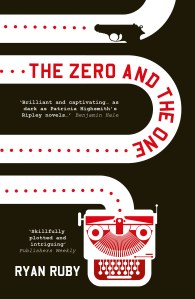
zero_one_high resA bookish scholarship student, Owen Whiting has high hopes of Oxford, only to find himself immediately out of place. Then he meets Zachary Foedern from New York. Rich and charismatic, Zach takes Owen under his wing, introducing him to a world Owen has only ever read about.
From Oxford to the seedy underbelly of Berlin, they dare each other to transgress the boundaries of convention and morality, until Zach proposes the greatest transgression of all: a suicide pact. But when Zach’s plans go horribly awry, Owen is left to pick up the pieces and navigate the boundaries between illusion and reality to preserve a hold on his once bright future.

About the Author:

Ryan RubyRyan Ruby was born in Los Angeles in 1983. He has written for The BafflerConjunctionsLapham’s Quarterlyn+1, and the Paris Review Daily among other publications, and has translated two novellas from the French for Readux Books. He lives in Berlin.


The Zero and the One by Ryan Ruby is out now and available from Amazon UK and Amazon US.

blog tours, guest post

#BlogTour #Content Dead North by Joel Hames. @joel_hames #DeadNorth @MainsailBooks @annecater

Dead north poster

Sometimes a guest post comes along that draws you in and takes you by surprise. The post that I’m sharing below did that. I wasn’t really sure what to expect as I didn’t know what author Joel Hames was going to be writing about, but I absolutely love the story that he told. Read it, you won’t regret it. I think that this story could be a book in itself.

Guest Post:

Lancashire, and half a world away

Hello @ifonlyread, thank you for hosting me, and hello everyone else, thank you for reading.

What I’m about to share is a true story, and the inspiration for the main sub plot in my latest novel, Dead North. I’ve changed the name of the principal person involved, and altered the locations and the dates, slightly, so as to afford some privacy to those affected. But the heart of it is completely and utterly true.

It was the back end of the millennium. 18 months to go until planes started falling from the sky and the world burned, or so they’d have had us believe. And I was in Patagonia, kicking myself, because if there was one place you’d want to be when the world did burn, it would, as Bruce Chatwin had recognised decades earlier, be Patagonia, and I was 18 months early.

I’d been hiking through South America for six months, prior to starting a career as a lawyer. My wife-to-be had joined me in Argentina, and we’d bussed and hitched our way down through the country, eating steak and learning to tango in Buenos Aires, revelling at the beauty of the Argentine Lake District, watching whales and penguins and elephant seals in Puerto Madryn, until we hit the huge, majestic wilderness of Patagonia.

We’d loaded up for a long hike. Dried food, tiny gas cooker, handy little tent, a lighter that could start a fire in the face of the most relentless Patagonian wind. Less than two hours into that hike, with the wind biting at our faces through alpaca-fleece hats, a van pulled up on the track beside us and asked whether we wanted a lift.

“It’s OK,” we said, eyeing the driver suspiciously. Contrary to everything we’d been told, Argentina had been a wonderfully friendly and safe place for us, so far, but we were on a deserted stretch of road, probably tens of miles from the nearest human being, and it paid to be cautious.

“Are you sure?” His English was good, accented but clear. He looked to be in his early thirties, maybe, tall and lean, ruggedly handsome, as most of the Patagonian men, to my chagrin, seemed to be. “You look like you’re in for a long walk. But with me, you can go much further. And you can enjoy it more, too.”

We laughed and thanked him. “It’s OK,” we said. “We like being outside, not in the van.”

“Not in the van,” he replied, clearly affronted by the suggestion. “We drive to my place. There, we take the horses.”

Our eyes lit up.

Over the next week our unexpected angel, Max, gave us everything he’d said he would and more. On horseback, we trebled the journey we’d been planning by foot, and although our knees might have been sore after eight hours in the saddle, our backs certainly thanked us, with the horses taking the load. We lit fires and feasted on milanesa, on steak and cartons of local red wine, on fish caught in remote icy rivers while we looked on and drank more of that wine. We saw more of Patagonia than we’d believed possible. We retired each night to our own tent while Max insisted on sleeping under the stars. Every morning we strolled down to the nearest river or mountain tarn and took a quick, refreshing dip. We laughed more than we’d laughed in years. And we enjoyed the company of Max, one of the kindest, most open, most charming men I had met in my life.

29345869_10155280179712623_1151289349_n

Me and my wife-to-be crossing a river on our steeds, Hercules and Sorpresa

29665918_10155280180437623_1802845867_n

When it was all over we disappeared, down to Tierra del Fuego, where we sat on trains with all the other tourists and admired the landscape and the old colonial vestiges, and missed Max, and on our way back up again we dropped in on him, pitched our tent in his field, and stayed with him for our last few days in Argentina, riding, chatting, drinking wine, drinking maté, the strange, bitter tea the Argentines consume by the gallon through metal straws, feasting, meeting Max’s friends and loving every minute of it. On our last night we sat in the field while he cooked up a giant asado, a barbecue of beef and lamb and sausages, and played with his German Shepherd, who’d accompanied us on our trek and had an unerring ability to find the nearest lake or river. The dog was also called Max – that was the dog’s real name, but I’m not going to change either of their names for this, because whenever I see the word, or hear it, or type it, I’m back there in that field, lying back on the grass laughing about something stupid with strangers-turned-friends as Max-the-owner scratched Max-the-dog behind his ear.

Max-the-dog, and my feet

29666601_10155280180932623_1124615510_n

And then we went home.

We dropped Max an email when we’d been back a few days. Everyone used Hotmail back then. Even in Patagonia, there were internet cafes, but not in the remote hill-country Max called home. We didn’t expect a reply any time soon, and we didn’t get one.

A few weeks went by. We dropped him another email. Still no reply. I dialled the number we had for him, and it rang and rang until it went silent. No voicemail or answerphone for Max.

A final try, a couple of months after that. By now we were settling into our new lives, gainfully employed, enjoying the fruits of London and our monthly pay checks and although we missed Argentina and Max, we had other things to think about. No answer to the phone call. No reply to the email. We moved on.

I didn’t spare Max much thought for another eighteen years.

When I sat down to write Dead North, I found two of the characters needed a back story. Most characters do. But I was drawn, by these two, to Argentina, to the Lake District, itself a gentler, kinder version of the Patagonian wilderness below. And for everything to come together, I needed Max. I thought it was time to try to get in touch with him again.

Of course, by 2016, we had Google, and finding out about Max was much easier than it had been back in 1998. And what I found was this:

Four weeks after we’d left him, Max had gone missing.

He’d not been seen since.

The police had done what they could, but the area was so vast that searching it properly was impossible. His horses were all present and accounted for. His girlfriend – a stewardess for a local airline, they’d not been together long – had a good alibi, as did everyone else who knew him well enough to be considered a suspect. Not that there was anything to suspect anyone of, really. Max had no enemies, as far as I knew – and the eighteen-year-old police statements to the local newspapers I painstakingly translated from Spanish into English said much the same thing. There was no sign of forced entry to his home. Nothing was missing.

There was something he’d mentioned, once, idly, that didn’t feature in any of the police statements, but he’d kept his distance, he said; it was nothing to do with him. The fact was, he lived in border country. The Andes he rode through split Argentina from Chile, and given the scale of the area and the difficulty of monitoring it, this was profitable territory for smugglers. People brought things over one way and brought other things back home. Max had been asked to help them, in the past. He’d declined.

This was, I was certain, entirely irrelevant. And after all these years, there was little hope that Max could be alive.

But there was nothing to stop me from reviving him.

I hope this doesn’t seem strange or distasteful to you. In both the novel and this account, I’ve changed names and locations. In the short time I knew him, Max was a good friend to me. I can hear him even now, turning a slab of meat on the parilla and laughing at something my wife-to-be had said, turning to her, saying, as he said so often, “that’s another history, eh?”, and knocking back a cup of cheap local wine.

His role in Dead North is small. But brief as it was, Max’s presence in my life looms surprisingly large.

Blurb:

Dead North 3D coverOnce the brightest star in the legal firmament, Sam Williams has hit rock bottom, with barely a client to his name and a short-term cash problem that’s looking longer by the minute. So when he’s summoned to Manchester to help a friend crack a case involving the murder of two unarmed police officers and a suspect who won’t say a word, he jumps at the chance to resurrect his career.

In Manchester he’ll struggle against resentful locals, an enigmatic defence lawyer who thinks he’s stepping on her toes, beatings, corrupt cops and people who’ll do anything to protect their secrets. On its streets, he’ll see people die. But it’s in the hills and valleys further north that Sam will face the biggest challenge of all: learning who he really is and facing down the ghosts of his past.

He’s working someone else’s case and he’s in way over his head. But sometimes you need the wrong man in the right place.

About The Author:

Joel Hames Author PicJoel Hames lives in rural Lancashire, England, with his wife and two daughters, where he works hard at looking serious and pretending to be a proper novelist.
After a varied career in London which involved City law firms, a picture frame warehouse, an investment bank and a number of market stalls (he has been known to cry out “Belgian chocolates going cheap over ‘ere” in his sleep), Joel relocated from the Big Smoke to be his own boss. As a result, he now writes what he wants, when he wants to (which by coincidence is when the rest of the family choose to let him).
Joel’s first novel, Bankers Town, was published in 2014, and The Art of Staying Dead followed in 2015. The novellas Brexecution (written and published in the space of ten days following the UK’s Brexit referendum, with half of the profits going to charity) and Victims were published in 2016 and 2017 respectively.

Joel’s website can be found at http://www.joelhamesauthor.com, where you can find out more about the writer and the books, and sign up to his email newsletter. If you want to know what Joel has planned for the future, what he thinks right now, or just stalk him a little, you can find him on Facebook at facebook.com/joelhamesauthor or Twitter at @joel_hames. Joel has never seen the word “Joel” appear as frequently as it does right here, and wholeheartedly approves.

Dead North by Joel Hames is out now and is available from Amazon UK and Amazon US.

blog tours, extract

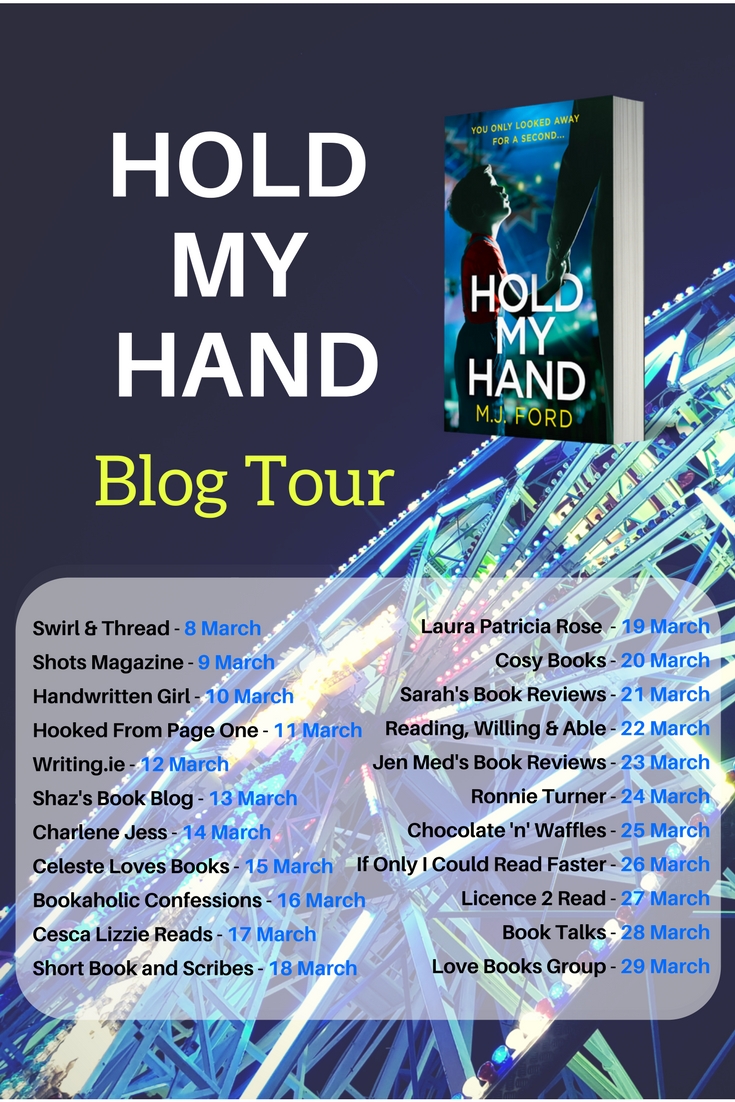
#BlogTour #Extract Hold My Hand by M.J. Ford @AvonBooksUK

HOLD MY HAND - Blog Tour

Today it is my stop on the blog tour for Hold My Hand by M.J. Ford. I really want to read this book, just the cover alone appeals, but I haven’t managed to fit it into my exploding to be read pile just yet. But I’m delighted to share an extract from the book to hopefully whet your appetite and wanting more.

Extract:

William ran towards her and Jo put down the box and braced herself as the six-year-old leapt in the air. She caught him, but almost lost her footing.

‘You weigh a tonne!’ she gasped.

‘Hi Auntie Jo,’ he said.

Amelia wafted through the crowds, a glass in hand ready to give to Jo. ‘Hello darling,’ she said. ‘Thanks for making the trip.’

‘Wouldn’t miss it,’ said Jo. Amelia was hard not to like.

Paul was looking good.

‘You’ve lost weight,’ Jo said.

‘He’s doing a triathlon in September,’ said Amelia. ‘He’ll be tapping you for sponsorship, so watch out.’

‘I’m broke!’ she said, managing a smile.

‘I’ve given up cheese,’ said Paul morosely. Then he pointed with his glass to the box. ‘Is that for me?’

‘I hope you like it,’ said Jo.

Whether it was the booze or not, his face lit up when his eyes landed on the homburg, and he paraded the hat in front of his guests.

‘You look like something out of le Carré!’ said Amelia, laughing. William tried it on as well, to much amusement.

‘Thanks sis!’ said Paul, giving her a peck on the cheek. ‘Actually, we could have done with you here a week ago. Car got broken into – they nicked my iPad. And my bloody squash racket of all things. Police didn’t even come out and take prints!’

Jo could tell a few people were listening, so just said jovially, ‘Sorry, bro – not my patch!’

She could have told them that the police force were suffering the deepest cuts since their inception, that manned stations were being phased out in all but the biggest towns, and that the few demoralised officers who did remain really couldn’t give a shit about someone stupid enough to leave their iPad on display in their vehicle.

Blurb:

image001

HOLD MY HAND, M. J. Ford

How long do you hunt for the missing?

A horrible vanishing act…

When a young Josie Masters sees a boy wearing a red football shirt, Dylan Jones, being taken by a clown at a carnival, she tries to alert the crowds. But it’s too late. Dylan has disappeared…

Thirty years later, Josie is working as a police officer in Bath. The remains of the body of a child have been found – complete with tatters of a torn red football shirt. Is it the boy she saw vanish in the clutches of the clown? Or is it someone else altogether?

And then another child disappears…

About The Author:

M. J. Ford lives with his wife and family on the edge of the Peak District in the north of England. He has worked as an editor and writer of children’s fiction for many years. Hold My Hand is his first novel for adults.

Hold My Hand by M.J. Ford is out now and available from Amazon UK and Amazon US.

3.5*, blog blast, blog tours, book review, debut author, psychological thriller

#BlogBlitz The Choice by Jake Cross @JakeCrossAuthor @Bookouture

The Choice - Blog Tour

My Review:

I enjoyed The Choice by Jake Cross, it’s a fast-paced read with lots happening, but in order to enjoy this book I think that you really need to just go with the book and not think about how realistic something is (or isn’t).

If you were driving along a road when it is dark and there are no houses or other cars around and suddenly in front of your car was a woman, you slam on the brakes and she begs you to help her, would you help? That’s what Karl is faced with at the start of this book, it is clear that the woman is terrified and so he decides to help her. But it soon becomes clear that people are after the woman and Karl knows that they have seen his van. The woman, Liz, insists that Karl is at risk, that the men she is running from will find him but he dismisses it. She also refuses to go to the police, something that Karl goes along with.

It soon becomes clear that Karl and his pregnant wife are in danger and Karl teams up with Liz to try and survive. This is when things get a little bit far-fetched, but if you ignore that then you’ll enjoy the ride!

Thank you to Bookouture for a copy of The Choice by Jake Cross, I was under no obligation to review the book and all thoughts are my own.

Blurb:

The-Choice-Kindle‘You’ve got to help me,’ she pleads.
On a wet road in the black of night, Karl Seabury is driving home to his pregnant wife. Suddenly, caught in his headlights in the middle of the road is a woman shaking with fright.

The woman says her name is Liz Smith, that her home was attacked, and that she was the only one to escape.

In a split-second decision, Karl decides to help her to safety. But Liz is hiding a dark secret and now his good deed has put his family in terrible danger…

An absolutely unputdownable thriller, with twist after twist after twist, that will leave you breathless. Perfect for fans of Robert Dugoni, John Marrs and Harlan Coben.

About The Author:

davJake has been making stuff up from a real early age. His parents never believed his silly lies when he was young, so he still has no idea why he thought he could invent a decent story as an adult. But he kept trying, and here we are. THE CHOICE is his first novel, the first of three thrillers to be published by Bookouture, and he hopes you like it. If you don’t, he at least hopes you don’t ask for a refund.


The Choice by Jake Cross is out today and available from Amazon UK and Amazon US.

4*, blog tours, book review

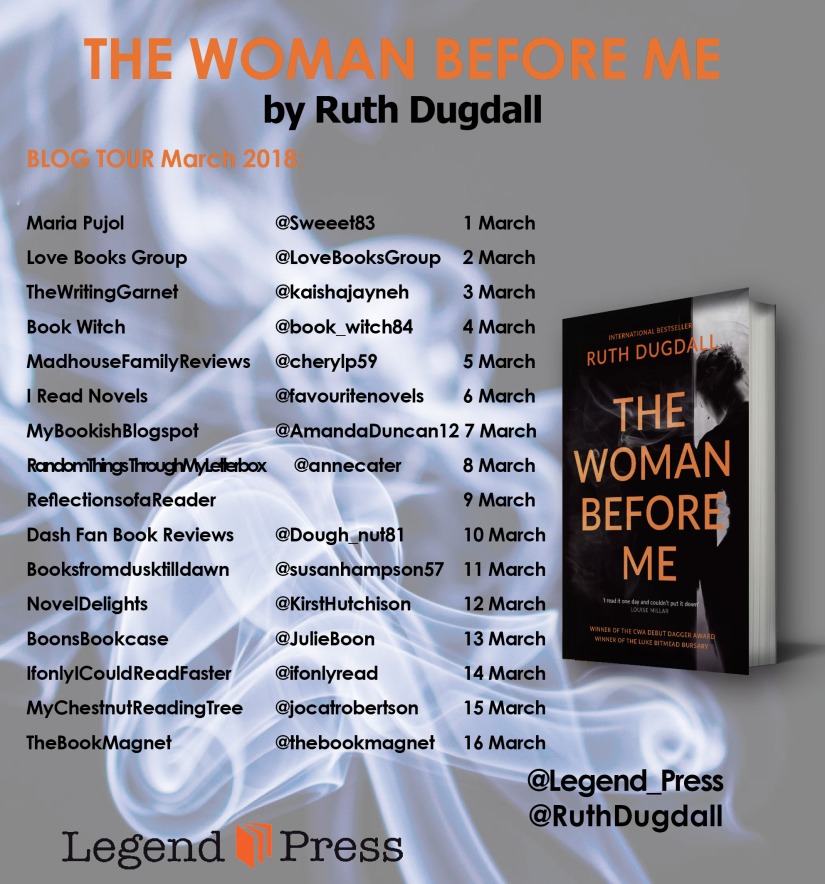
#BlogTour The Woman Before Me by Ruth Dugdall. @RuthDugdall @LegendPress

the woman before me Blog Tour Banner jpeg

My Review:

It isn’t usual that I will read a series out of order, but that is most definitely what I have done with the Cate Austin books. The first one that I read was book four, Nowhere Girl, which I thought was a brilliant book. Keen to read more I then read Humber Boy B which is number three and was even better than Nowhere Girl. And now I have read book one, The Woman Before Me.

I actually don’t think that it has mattered reading them out of sync and I found it quite amusing reading this book and knowing how far Cate as a character develops over the series.

Although this book is the start of the Cate Austin series, Cate herself is very much a minor role in The Woman Before Me, although a very crucial one.

Rose is most definitely the main character and the majority of the book is told by her. She’s a complex character and I was never sure how reliable she was, as we follow her as she hopes for parole. The book goes back to the past when Rose met her partner and the birth of her little boy Joel.

We know that Joel died and we know that Rose is in prison for the murder of another little boy called Luke, and as the story evolves the truth about what really happened becomes clear. I have to admit that I worked it out quite early on but I still really enjoyed it and a few times I decided that I had got it wrong.

Dugdall is a great storyteller and I love her characters, she has a real way of making them feel real. I love how her characters deal with what life throws at them, there’s no dramatics in her writing and as a result the characters are more believable.

I’ve really enjoyed the Cate Austin series and think that they get better and better. I now need to read number two to complete the set!

Thank you to Legend Press for a copy of The Woman Before Me by Ruth Dugdall, I was under no obligation to review the book and all thoughts are my own.

Blurb:

‘An absolute tour de force that left me thinking for days.’ Alex Marwood

They came for me, just like I knew they would. Luke had been dead for just three days.

Rose Wilks’ life is shattered when her newborn baby Joel is admitted to intensive care. Emma Hatcher has all that Rose lacks. Beauty. A loving husband. A healthy son. Until tragedy strikes and Rose is the only suspect.

Now, having spent nearly five years behind bars, Rose is just weeks away from freedom. Her probation officer Cate must decide whether Rose is remorseful for Luke’s death, or whether she remains a threat to society. As Cate is drawn in, she begins to doubt her own judgement.

Where is the line between love and obsession, can justice be served and, if so… by what means?

New Edition includes exclusive material and author Q&A.

About The Author:

ruthdugdallRuth Dugdall was born in 1971. She holds a BA honours degree in English Literature (Warwick University) and an MA in Social Work (University of East Anglia). She qualified as a probation officer in 1996 and has worked in prison with offenders guilty of serious crimes, including stalking, rape and murder. This has informed her crime writing. Since she started writing, Ruth has won awards in several writing competitions, and has had short stories published in the Winchester Writers’ Conference and the Eva Wiggins Award anthologies.


The Woman Before Me by Ruth Dugdall is out now and available from Amazon UK and Amazon US.

blog tours, guest post, true crime

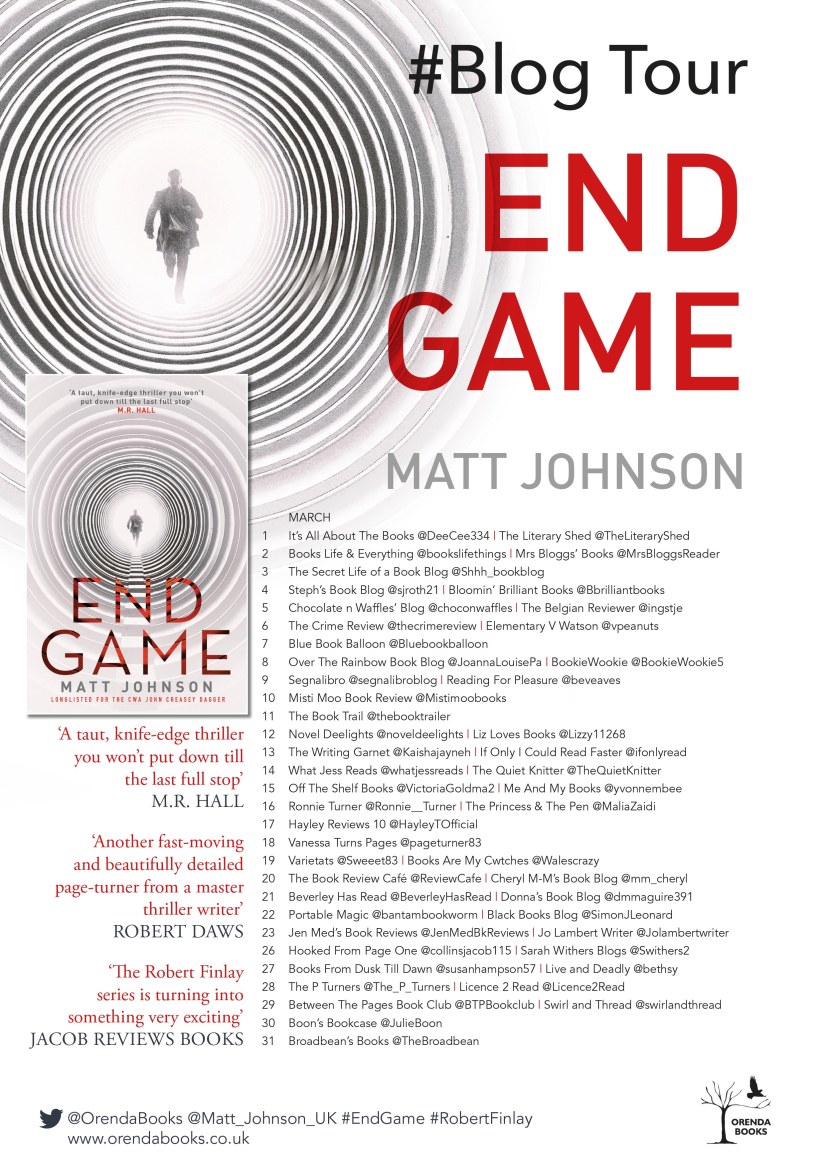
#BlogTour End Game by Matt Johnson @Matt_Johnson @OrendaBooks #EndGame

End Game blog poster 2018 1

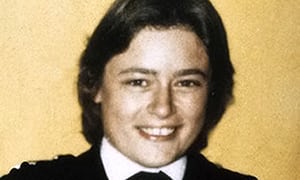
Today it’s my stop on the blog tour for End Game by Matt Johnson, published by Orenda Books. Matt has written an incredibly powerful account of losing his friend, WPC Yvonne Fletcher. End Game is the final part of the Robert Finlay trilogy.

Losing a friend 

17th April sees the 36th anniversary of one of the worst days I have ever experienced. It is a day when a friend and colleague was shot and killed. Three decades later, despite the identity of the killer being known, he remains a free man.

2400

On 17th April 1984 I was a 27 year old advanced car driver working in central London on a police traffic car. WPC Yvonne Fletcher was a 25 year old officer on the Vice Squad at West End Central Police Station. My wife of the time served on this same squad. Yvonne was one of her best mates and part of our circle of friends.

Yvonne had been at a house-warming party at my home a few weeks before this fateful day. My lasting memory of her is of seeing her sitting at the bottom of the stairs in my house, looking relaxed and chatting with friends.

At 10.18 am Yvonne was with a small contingent of officers supervising a demonstration outside the Libyan Peoples Bureau in St James Square, London. Her fiancé was among the officers with her. Yvonne had her back to the Bureau.

Without warning, someone in the Libyan bureau fired a Sterling submachine gun into the group of protesters and police officers. Eleven people were hit by bullets, including Yvonne.

WPC_Yvonne_Fletcher_shortly_after_being_shot

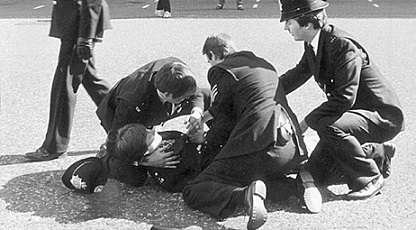
Severely injured WPC Yvonne Fletcher being helped by colleagues

An ambulance was quickly sent to the scene and my patrol car was sent to escort the ambulance to the Westminster Hospital.

Anyone who has worked in central London will know just how quickly a major incident can cause the streets to become blocked. Main roads rapidly snarl up and the side streets and rat runs that the taxis and locals use, soon follow. Gridlock is the result.

Getting the ambulance to the hospital proved to be a nightmare. We were forced to drive onto pavements and, on several occasions, we had to get out of the car to get vehicles moved so we could get through. At that time we were aware that the casualty was a police officer, but didn’t know who.

I remember that the ambulance overtook the police car just before we reached the hospital. We had to get out of the car to clear traffic from a junction and the crew seized the opportunity to make progress and get through. When we pulled in behind the ambulance, Yvonne had already been taken into the emergency area. I remember seeing the fantastic efforts and the work that was being put in by the nursing staff to help her. They were fantastic and couldn’t have tried harder.

Yvonne died from her wounds one hour later. She had been shot in the back and abdomen.

After escorting the ambulance, my car was sent to help with the traffic chaos that followed the start of the resulting siege.

I went home that afternoon and switched on the six o’clock news. It was only then that my former wife and I learned that the murdered officer was our friend.

The following day, I was assigned as a driver to the SAS team that had been brought in and stationed at a nearby RAF base. My job was to run the lads around, in short I was a gofer and taxi driver. I made frequent trips to the infamous ‘blue screen’ that was built to block the view into the square and I was present on the night that something amazing happened.

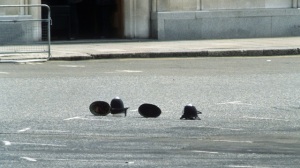
Yvonne’s hat and four other officers’ helmets were left lying in the square during the siege of the embassy. Images of them were shown repeatedly in the British media. They came to represent something quite iconic as a symbol of unarmed police officers who had been attacked so ruthlessly.

yvonne-hat1

What happened was that a PC, acting completely on his own, ran into the square and snatched Yvonne’s hat. There were shouts of ‘get back, get back’ from the firearms officers but the unarmed PC was determined and fast. As he returned to the blue screen, he was bundled away by a senior officer and a firearms officer. I never did find out what happened to the PC but I suspect he got into trouble.

Fact is, what he did was a reckless thing to do. It is quite possible that the hat may have been playing a part in the hostage negotiations that were going on behind the scenes. We will never know. But what I can tell you is how much that PCs actions lifted the spirits of people like me who were sitting watching while the ‘powers that be’ seemed to be doing very little. Grabbing Yvonne’s hat from under the noses of the terrorists stuck two fingers up to them and told them what we thought of them.

To that anonymous PC, I say thanks.

The ‘Peoples Bureau’ was surrounded by armed police for eleven days, in one of the longest police sieges in London’s history. Meanwhile, in Libya, Colonel Gaddafi claimed that the embassy was under attack from British forces, and Libyan soldiers surrounded the British Embassy in Tripoli.

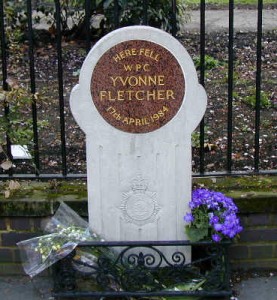
No satisfactory conclusion was reached in the UK, and following the taking of six hostages in Tripoli, the occupiers of the Bureau were allowed to fly out of the UK. The Tripoli hostages were not released for several months, ironically almost on the exact day that the memorial to Yvonne Fletcher was unveiled.

In July 2012 Andrew Gilligan of The Sunday Telegraph received reliable reports that Salah Eddin Khalifa, a pro-Gaddafi student, fired the fatal shot. Unlike a previous suspect named as the killer, Mr Khalifa is known to be alive and may, one day, be arrested. He is currently living in Cairo, a city to which he moved as the Gaddafi regime crumbled.

yvonne-memorial

Yvonne’s death is still the only murder of a British cop on UK soil to remain unsolved.

But, we haven’t forgotten.

Blurb:

Robert Finlay seems to have finally left his SAS past behind him and is settled into his new career as a detective. But when the girlfriend of his former SAS colleague and close friend Kevin Jones is murdered, it’s clear that Finlay’s troubles are far from over. Jones is arrested for the killing, but soon escapes from jail, and Finlay is held responsible for the breakout. Suspended from duty and sure he’s being framed too, our hero teams up with MI5 agent Toni Fellowes to find out who’s behind the conspiracy. Their quest soon reveals a plot that goes to the very heart of the UK’s security services. End Game, the final part in the critically acclaimed Robert Finlay trilogy, sees our hero in an intricately plotted and terrifyingly fast-paced race to uncover the truth and escape those who’d sooner have him dead than be exposed.

About The Author:

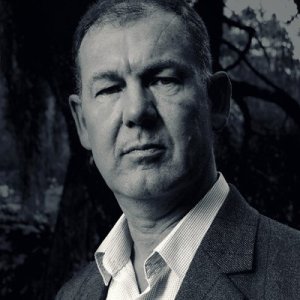
Matt Johnson Author PictureMatt Johnson served as a soldier from 1975-78 and Metropolitan Police officer from 1978 -1999.

His debut novel Wicked Game – a crime thriller – was published by Orenda Books in March 2016. The sequel Deadly Game, was published in March 2017, the finale End Game, in March 2018.


In 1999, Matt was discharged from the police with Post Traumatic Stress Disorder. Whilst undergoing treatment, he was encouraged by his counsellor to write about his career and his experience of murders, shootings and terrorism.

Matt was eventually persuaded to give this a go, and one evening, he sat at his computer and started to weave his notes into a work of fiction that he described as having a tremendously cathartic effect on his own condition. He used his detailed knowledge and recollections to create what has been described by many readers as a fast paced, exciting and authentic tale of modern day policing and terrorism.

I could be argued that Matt Johnson is living proof PTSD is a condition that can be controlled and overcome with the right help and support. He has been described by many fans as an inspiration to fellow sufferers.

Matt is represented by James Wills of Watson Little, Literary Agents and by Kaye Freeman of Andromeda Talent. The former for all literary, audio, tv and film rights; the latter for all public speaking engagements.

End Game by Matt Johnson is out now and available from Amazon UK and Amazon US.
4*, blog blast, blog tours, book review

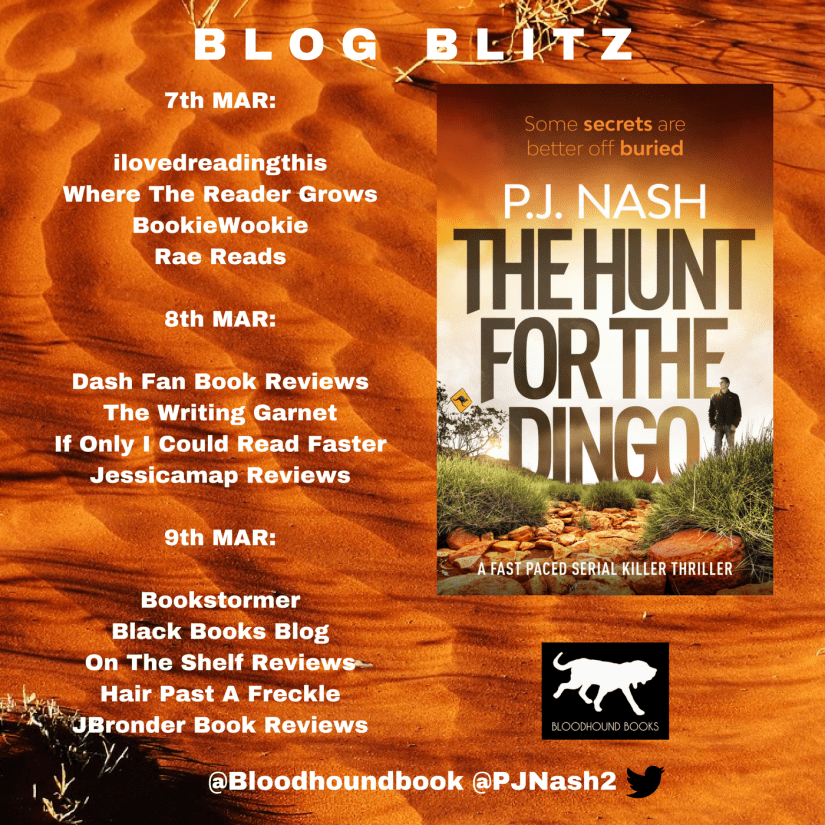
#BlogBlitz The Hunt For The Dingo by P.J. Nash. @PJNash2 @Bloodhoundbook #bookreview

B L O G B L I T Z (1).png

My Review:

When I read the blurb for The Hunt For The Dingo by P.J. Nash I knew that I wanted to read it, actually it was just the cover that made that decision for me, how could you not love it?

Having visited Australia and knowing how vast the country is and how the outback would make a great setting for any thriller I was excited to read this book. I also have a bit of a thing about Dingos but of course in this book the Dingo in question isn’t actually an animal but a person.

The Hunt For The Dingo is a really fast paced read, it has short chapters that keep the tension going and although it isn’t a long book at under 200 pages the author keeps the reader wanting more right to the very end.

I just wished that I had been able to get to know some of the characters a little bit more, perhaps if a few more pages had been added to the book with more details about the characters within then this book would have really worked, because although I really enjoyed reading it I felt a little bit disconnected from the characters.

Overall a great read, I look forward to reading more from the author.

Thank you to Bloodhound Books for a copy of The Hunt For The Dingo by P.J. Nash. I was under no obligation to review and all thoughts are my own.

Blurb:

 P.J. Nash - The Hunt for the Dingo_cover_high resA fast paced serial killer thriller
In the arid expanses of Australia’s red deserts, a killer is preying on British female backpackers. Dubbed ‘The Dingo’ by the media, he stalks his prey then disappears without a trace.
In a bid to catch the man responsible, the local police call on the talents of Melbourne’s finest, ex British cop, Lawrence James and leading criminal psychologist Jesse Sandersen.
Meanwhile, James has unfinished business with Melbourne crime kingpin, Cyrus Bain, a gangster who will do whatever it takes to stay out of jail.
When another young girl disappears, it is a race against time to catch the killer.
Can James bring The Dingo to justice?
Will he escape with his life intact?
In their hunt for the murderer, James and Sandersen unearth some disturbing secrets that many would rather remain buried.

About The Author:

P.J+NashP.J Nash was born in Nuneaton, Warwickshire, the birthplace of George Eliot and Shakespeare, respectively. Not surprisingly he decided he’d like to be a writer too.

After studying history and working in PR for a few years, he was running a second hand bookshop, when wanderlust and destiny in the form of his future wife took him to Prague.

During his time behind the counter in the shop and travelling on trams between English lessons he wrote his first crime novel, The Hunt for the Dingo featuring maverick British expat cop , Lawrence James and and his hunt for a serial killer in Australia. On his return to the UK, he drew on his Bohemian adventures to write his second crime novel featuring Lawrence James and his co-investigator, Dr Jessie Sandersen.  He currently lives on a narrowboat with his wife Clare and grumpy cat, Lulu.

In his past life P.J. Nash was a Special Constable for the Warkwickshire police.

Nash is also a member of the CWA and International Thriller Writers.

www.facebook.com/pjnash.501

The Hunt For The Dingo by P.J. Nash is out now and available from Amazon UK and Amazon US.

4*, blog tours, book review

#BlogTour: 37 Hours by J.F. Kirwan. @kirwanjf @UKCarina @rararesources

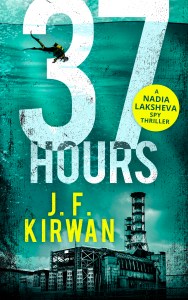
37 Hours Full Banner

My Review:

Having read and enjoyed book one in the series I was looking forward to reading 37 Hours and finding out what was next for Nadia and Jake and what they were going to get themselves into this time.

The book did not disappoint because once again Nadia gets herself caught up in a whole lot of trouble. Once again the threat is nuclear and it takes all that Nadia has along with the help of MI6 as they race against time to find a stolen warhead.

37 Hours had many twists and turns and lots of unexpected events that kept the pace going and the tension rising. I had really like the character Jake in the first book and I was disappointed that he didn’t feature more in this book but hopefully book three will make up for that.

The diving remains a central part of the plot but this time there are also some recreational dives to enjoy which I liked, although sharks were a little too demonised in my opinion which was a shame.

I do think that to fully understand the plot of 37 Hours the reader needs to have read the first book in the series, 66 Metres as Nadia especially has so much history that there would be big gaps missing if you hadn’t started the story at the beginning.

Overall this is a great read, it’s fast paced and will keep the reader hooked and guessing what will happen next. I’m now looking forward to reading book three in the series.

Thank you to the publisher for a copy of 37 Hours, I was under no obligation to review the book and all thoughts are my own.

Blurb:

37 Hours_FINALAfter two long years spent in a secret British prison, Nadia Laksheva is suddenly granted her freedom. Yet there is a dangerous price to pay for her release: she must retrieve the Russian nuclear warhead stolen by her deadliest enemy, a powerful and ruthless terrorist known only as The Client.

But her mysterious nemesis is always one step ahead and the clock is ticking. In 37 hours, the warhead will explode, reducing the city of London to a pile of ash. Only this time, Nadia is prepared to pull the trigger at any cost…

The deadly trail will take her from crowded Moscow to the silent streets of Chernobyl, but will Nadia find what she is looking for before the clock hits zero?

About The Author:

KIRWAN Barry 01 ret 6x8J. F. Kirwan is the author of the Nadia Laksheva thriller series for HarperCollins. Having worked in accident investigation and prevention in nuclear, offshore oil and gas and aviation sectors, he uses his experience of how accidents initially build slowly, then race towards a climax, to plot his novels.

An instructor in both scuba diving and martial arts, he travels extensively all over the world, and loves to set his novels in exotic locations. He is also an insomniac who writes in the dead of night. His favourite authors include Lee Child, David Baldacci and Andy McNab.

33 Hours by J.F. Kirwan is out now and available from Amazon UK and Amazon US.

You can also read my review of book one in the series, 66 Metres here.